---
title: "Temperature and SEU Sensitivity: Ellsberg Study"
subtitle: "Application Report: Ellsberg Study"
description: |
An investigation of how LLM sampling temperature affects estimated
sensitivity (α) to subjective expected utility maximization, using
Ellsberg-style urn gambles (K=4) and Claude 3.5 Sonnet (Anthropic).
This study tests whether the monotonic temperature–α relationship found
in the initial temperature study (GPT-4o, insurance triage) generalizes
to a different task domain and a different foundational model.
categories: [applications, temperature, ellsberg, m_02, anthropic]
bibliography: ../../references.bib
execute:
cache: true
---
```{python}
#| label: setup
#| include: false
import sys
import os
reports_root = os.path.normpath(os.path.join(os.getcwd(), '..', '..'))
project_root = os.path.dirname(reports_root)
sys.path.insert(0, reports_root)
sys.path.insert(0, project_root)
import numpy as np
import json
import re
import warnings
warnings.filterwarnings('ignore')
import matplotlib.pyplot as plt
import pandas as pd
# Use project plotting style
from report_utils import set_seu_style, SEU_COLORS, SEU_PALETTE
set_seu_style()
# Data directory (frozen snapshot — immune to future pipeline runs)
from pathlib import Path
data_dir = Path("data")
```
## Introduction {#sec-introduction}
The initial temperature study ([Report 1](../temperature_study/01_initial_study.qmd)) established a clear negative relationship between LLM sampling temperature and estimated sensitivity $\alpha$ to subjective expected utility maximization. Higher temperature yielded lower $\alpha$, with a posterior slope $\Delta\alpha / \Delta T \approx -25$ and $P(\text{slope} < 0) > 0.99$. That study used **GPT-4o** (OpenAI) on an **insurance claims triage** task with $K = 3$ consequences.
A natural question is whether this finding generalizes: does it depend on the specific task domain, the specific LLM, or both? Answering this question requires a $2 \times 2$ factorial design crossing LLM (GPT-4o vs. Claude 3.5 Sonnet) with task domain (insurance triage vs. Ellsberg gambles). This report describes one cell of that design — **Claude 3.5 Sonnet on Ellsberg gambles** — which changed both factors simultaneously relative to the initial study:
- **Task domain**: Ellsberg-style urn gambles with monetary payoffs instead of insurance claims triage. The consequence space expands to $K = 4$ ($\$0, \$1, \$2, \$3$). Alternatives range from fully-specified (known ball counts) to maximally ambiguous (unknown mixture), inspired by @ellsberg1961's seminal paradox. The classic Ellsberg finding is that human decision-makers prefer known-probability gambles over ambiguous ones, violating the Sure-Thing Principle of @savage1954's subjective expected utility theory — a pattern known as *ambiguity aversion* [@gilboa1989; @machina2014]. Whether LLMs exhibit an analogue of this bias is an open question that this task domain can begin to address.
- **Foundational model**: Claude 3.5 Sonnet (Anthropic) instead of GPT-4o (OpenAI).
Because this study changed both factors simultaneously, a non-replication cannot be attributed to either factor alone — nor can interaction effects (where one LLM might respond to temperature differently depending on the task) be identified. The two additional conditions needed to complete the factorial (Claude × Insurance and GPT-4o × Ellsberg) are reported in Reports 5–6 of this series, with the full factorial synthesis in Report 7.
The hypothesis was the same as in the original study: increasing the sampling temperature should monotonically decrease estimated $\alpha$.
::: {.callout-important}
## Summary of Findings
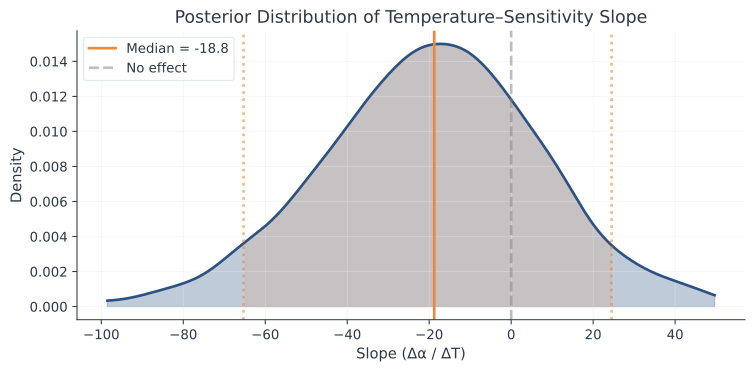
The monotonic temperature–α relationship observed in the initial temperature study was **not replicated** in this study. The posterior slope is $\Delta\alpha / \Delta T \approx -19$ but with substantial uncertainty ($P(\text{slope} < 0) \approx 0.77$), and the per-temperature $\alpha$ estimates exhibit a non-monotonic pattern. The model fits adequately at every temperature level — the non-replication reflects the behavior of the data, not a modeling artifact. Because this study changed both the task and the LLM simultaneously, the non-replication cannot be attributed to either factor alone, nor can it rule out an interaction between them. This analysis pools across the three ambiguity tiers of the Ellsberg gamble set and therefore addresses overall SEU sensitivity rather than ambiguity aversion or tier-specific processing (see Discussion). Cross-cell attribution — main effects of LLM and task, and any interaction — is addressed in the [Factorial Synthesis](../factorial_synthesis/01_factorial_synthesis.qmd).
:::
## Experimental Design {#sec-design}
### Task and Conditions
We use Ellsberg-style urn gambles in which Claude 3.5 Sonnet selects which gamble to play from a set of alternatives. Each gamble describes an urn containing colored balls with specified (or partially specified) counts, and payout rules mapping ball colors to one of $K = 4$ monetary consequences ($\$0, \$1, \$2, \$3$). In each decision problem, the LLM is presented with a subset of these gambles. The LLM first *assesses* each gamble individually (producing text that is then embedded), and subsequently makes a *choice* among the gambles in a given problem.
Five temperature levels define the between-condition factor:
```{python}
#| label: tbl-conditions
#| tbl-cap: "Experimental conditions. Each temperature level constitutes a separate model fit."
conditions = pd.DataFrame({
    'Level': [1, 2, 3, 4, 5],
    'Temperature': [0.0, 0.2, 0.5, 0.8, 1.0],
    'Description': [
        'Deterministic (greedy decoding)',
        'Low variance',
        'Moderate variance',
        'High variance',
        'Maximum (Anthropic API limit)'
    ]
})
conditions
```
::: {.callout-note}
## Temperature Range
The Anthropic API supports temperature values in $[0.0, 1.0]$, compared to $[0.0, 2.0]$ for OpenAI. The initial temperature study used $T \in \{0.0, 0.3, 0.7, 1.0, 1.5\}$. Here we use $T \in \{0.0, 0.2, 0.5, 0.8, 1.0\}$ — five levels spanning the full Anthropic-supported range. This is a narrower absolute range, which reduces statistical power for detecting the temperature effect.
To quantify the impact: using the initial study's slope estimate ($\Delta\alpha / \Delta T \approx -25$), the expected $\alpha$ difference over $[0, 1.0]$ would be approximately $-25$, compared to approximately $-38$ over the initial study's full $[0, 1.5]$ range. More critically, the initial study's strongest effect separation occurred between $T \leq 0.7$ and $T \geq 1.0$, with the $T = 1.5$ condition playing a pivotal role. This study's entire temperature range falls within the initial study's low-to-moderate regime, which could attenuate effect detection even if the underlying relationship were identical.
:::
### Alternative Pool
The alternative pool consists of 30 Ellsberg-style urn gambles organized into three ambiguity tiers:
- **Tier 1 (no ambiguity, E01–E08):** All ball counts are explicitly stated. These function like risky alternatives with known objective probabilities.
- **Tier 2 (moderate ambiguity, E09–E20):** Some ball counts are bounded by "at least" or "at most" constraints. The total is always stated.
- **Tier 3 (high ambiguity, E21–E30):** Only one color's count is known; the rest is described as an unknown mixture. This is closest to Ellsberg's original setup.
```{python}
#| label: tbl-pool-summary
#| tbl-cap: "Alternative pool summary. All 30 gambles use K=4 monetary consequences."
pool_summary = pd.DataFrame({
    'Tier': ['1: No ambiguity', '2: Moderate', '3: High'],
    'Alternatives': ['E01–E08 (8)', 'E09–E20 (12)', 'E21–E30 (10)'],
    'Ball counts': ['Fully specified', 'Partially bounded', 'Mostly unknown'],
    'Urn sizes': ['60–120', '80–120', '60–120'],
})
pool_summary
```
To illustrate the three tiers concretely:
- **Tier 1 example (E01):** An urn contains 100 balls — exactly 40 red, 30 blue, 20 green, and 10 white. Drawing red pays \$3, blue pays \$1, green pays \$2, white pays \$0. All probabilities are fully specified (EV = \$1.70).
- **Tier 2 example (E09):** An urn contains 90 balls — exactly 30 are red; of the remaining 60, at least 15 are black and at least 15 are yellow, but the exact split is unknown. Drawing red pays \$3, black pays \$1, yellow pays \$0. Some probabilities are bounded but not precise.
- **Tier 3 example (E21):** An urn contains 90 balls — exactly 30 are red; the remaining 60 are an unknown mixture of black and yellow balls. Drawing red pays \$3, black pays \$1, yellow pays \$0. This is closest to Ellsberg's original setup: one color's probability is known, but the rest are genuinely ambiguous.
The tiered structure provides a systematic gradient from risk (known probabilities) to Knightian uncertainty (unknown probabilities), connecting naturally to @ellsberg1961's original paradigm. Importantly, the current analysis applies a single SEU model to all alternatives pooled across tiers. This is appropriate as an overall sensitivity measure, but it means the model assumes point-valued subjective probabilities even for ambiguous alternatives — an assumption that is violated if the LLM exhibits ambiguity aversion. See @sec-discussion for further discussion of this limitation.
### Design Parameters
```{python}
#| label: design-params
#| echo: true
# Load frozen study configuration
import yaml

with open(data_dir / "study_config.yaml") as f:
    config = yaml.safe_load(f)

# Load run summary for pipeline details
with open(data_dir / "run_summary.json") as f:
    run_summary = json.load(f)

print(f"Study Design:")
print(f"  Decision problems (M):      {config['num_problems']} base × {config['num_presentations']} presentations = {config['num_problems'] * config['num_presentations']}")
print(f"  Alternatives per problem:    {config['min_alternatives']}–{config['max_alternatives']}")
print(f"  Consequences (K):            {config['K']}")
print(f"  Embedding dimensions (D):    {config['target_dim']}")
print(f"  Distinct alternatives (R):   {run_summary['phases']['phase3_data_prep']['per_temperature']['0.0']['R']}")
print(f"  LLM model:                   {config['llm_model']}")
print(f"  Embedding model:             {config['embedding_model']}")
print(f"  Provider:                    {config['provider']}")
```
Each of the 100 base problems is presented $P = 3$ times with gambles shuffled to different positions, yielding approximately $M = 300$ observations per temperature condition. This **position counterbalancing** design addresses systematic position bias. Any unparseable response is recorded as NA rather than assigned a default.
::: {.callout-note collapse="true"}
## Position Counterbalancing Effectiveness
Across all conditions, the distribution of choices across ordinal positions (first-listed, second-listed, etc.) was examined and the proportion of choices selecting the first-listed alternative was consistent with what would be expected given the varying number of alternatives per problem (we did not detect a systematic position bias in this descriptive check). The counterbalancing protocol (three shuffled presentations per base problem) is designed to make any residual position effects approximately orthogonal to gamble identity, substantially reducing the risk that position confounds $\alpha$ estimation.
:::
### Feature Construction
Alternative features are constructed through the same two-stage process used in the initial temperature study. First, Claude 3.5 Sonnet assesses each gamble at the relevant temperature, producing a natural-language evaluation. These assessments are embedded using `text-embedding-3-small` (OpenAI), yielding high-dimensional vectors. Second, all embeddings across temperature conditions are pooled and projected via PCA to $D = 32$ dimensions.
Pooling embeddings across temperatures before PCA means the resulting basis reflects a mixture of temperature-dependent and gamble-specific variation. Since the embedding model (`text-embedding-3-small`) is deterministic and operates on Claude's assessment text — which may vary in length and phrasing at higher temperatures — some temperature-induced embedding shift is possible. The PCA variance summary below shows that the dominant components capture a substantial share of variance (the first component alone explains 27%, and 32 components retain 87.8% of the variance, comparable to the initial study). We do not separately decompose the variance into gamble-level and temperature-level components in this report; the interpretation that the leading components primarily reflect gamble-level structure is consistent with the design (the assessments describe the same underlying urn structure regardless of temperature) but is not formally established here.
```{python}
#| label: pca-variance
#| echo: false
pca = run_summary['phases']['phase3_data_prep']['pca_summary']
cumvar = np.cumsum(pca['explained_variance_ratio'])
print(f"PCA Summary:")
print(f" Components retained: {pca['n_components']}")
print(f" Total variance explained: {pca['total_explained_variance']:.1%}")
print(f" First 5 components: {cumvar[4]:.1%}")
print(f" First 10 components: {cumvar[9]:.1%}")
```
### Data Quality
::: {.callout-note collapse="true"}
## Confirmatory vs. Exploratory Status
This study was designed as a follow-up to the initial temperature study (Report 1), with the analysis pipeline pre-specified to mirror that report: the same model structure (adapted for $K = 4$), the same prior calibration procedure, the same posterior predictive checks, and the same monotonicity analysis. The hypothesis (monotonic decline of $\alpha$ with temperature) was stated before data collection. The factorial extension (Reports 5–7) was motivated by the non-replication observed here and was not part of the original study plan. Accordingly, the primary analysis should be regarded as confirmatory, while the factorial framing introduced in the Discussion is exploratory.
:::
```{python}
#| label: data-quality
#| echo: false
na = run_summary['phases']['phase2b_choices']['na_summary']
print(f"NA Summary:")
print(f" Overall: {na['overall']['na']} / {na['overall']['total']} ({na['overall']['na_rate']:.1%})")
for key, val in na['per_temperature'].items():
print(f" {key}: {val['na']} / {val['total']} ({val['na_rate']:.1%})")
```
The overall NA rate of 1.4% is low and comparable to the initial temperature study. The slight increase in NA rate at higher temperatures is consistent with the expectation that higher-entropy token sampling occasionally produces unparseable responses.
### Comparison with Initial Temperature Study
```{python}
#| label: tbl-design-comparison
#| tbl-cap: "Design comparison between the initial temperature study and the Ellsberg study."
comparison = pd.DataFrame({
    'Parameter': ['LLM', 'Task domain', 'Consequences (K)',
                  'Alternatives (R)', 'Observations per T',
                  'Temperature range', 'Embedding model', 'Stan model'],
    'Initial study': ['GPT-4o (OpenAI)', 'Insurance claims triage', '3',
                      '30', '~300', '[0.0, 0.3, 0.7, 1.0, 1.5]',
                      'text-embedding-3-small', 'm_01'],
    'This study': ['Claude 3.5 Sonnet (Anthropic)', 'Ellsberg urn gambles', '4',
                   '30', '~300', '[0.0, 0.2, 0.5, 0.8, 1.0]',
                   'text-embedding-3-small', 'm_02'],
})
comparison
```
## Model and Prior Calibration {#sec-model}
### The m_02 Model Variant
The model uses the following key parameters (see the [foundations reports](../foundations/) for complete derivations):
| Symbol | Name | Description |
|--------|------|-------------|
| $\alpha$ | Sensitivity | Softmax inverse-temperature governing choice consistency with SEU |
| $\beta$ | Feature weights | $K \times D$ matrix mapping features to subjective probabilities |
| $\delta$ | Utility increments | Simplex ensuring ordered utilities |
| $\psi$ | Subjective probabilities | $\text{softmax}(\beta \cdot x)$ for each alternative |
| $\eta$ | Expected utility | $\psi \cdot \upsilon$ for each alternative |
| $\chi$ | Choice probabilities | $\text{softmax}(\alpha \cdot \eta)$ within each problem |
We fit the **m_02** model, which is structurally identical to the foundational m_0 model. The only difference is the prior on $\alpha$, calibrated for the Ellsberg study's $K = 4$ consequence space:
| | m_0 (foundational) | m_01 (initial study) | m_02 (this study) |
|---|---|---|---|
| $\alpha$ prior | $\text{Lognormal}(0, 1)$ | $\text{Lognormal}(3.0, 0.75)$ | $\text{Lognormal}(3.5, 0.75)$ |
| Prior median | $\approx 1$ | $\approx 20$ | $\approx 33$ |
| Prior 90% CI | $[0.19, 5.0]$ | $[5.5, 67]$ | $[10, 124]$ |
| $K$ | generic | 3 | 4 |
| All other priors | — | Identical to m_0 | Identical to m_0 |
The m_02 prior is slightly wider than m_01's because the larger $K = 4$ consequence space spreads expected utilities across alternatives differently, flattening the softmax response so that higher $\alpha$ values are needed to achieve comparable SEU-maximization rates. (This is *not* because the random-choice baseline changes: the menu size $N_m \in \{2, 3, 4\}$ is the same in both studies, so a uniform-random chooser selects the SEU-maximizer at the same rate regardless of $K$.)
### Prior Predictive Grid Search
We conducted the same grid-search procedure used for the initial study, but with the Ellsberg study's Stan data ($K = 4$, $D = 32$, $R = 30$).
```{python}
#| label: fig-grid-search
#| fig-cap: "Prior predictive grid search results for K=4 Ellsberg gambles. The selected prior lognormal(3.5, 0.75) yields a prior-implied SEU-max rate of approximately 0.76."
with open(data_dir / "grid_results.json") as f:
    grid = json.load(f)

results = grid['results']

fig, axes = plt.subplots(1, 2, figsize=(12, 5))

# Left: SEU rate by prior
labels = [r['prior_label'] for r in results]
means = [r['seu_rate_mean'] for r in results]
q05s = [r['seu_rate_q05'] for r in results]
q95s = [r['seu_rate_q95'] for r in results]

y_pos = np.arange(len(labels))
errors = np.array([[m - q05, q95 - m] for m, q05, q95 in zip(means, q05s, q95s)]).T

colors = [SEU_COLORS['accent'] if 'lognormal(3.5, 0.75)' in l else SEU_COLORS['primary']
          for l in labels]

axes[0].barh(y_pos, means, xerr=errors, color=colors, alpha=0.8,
             edgecolor='white', capsize=3)
axes[0].set_yticks(y_pos)
axes[0].set_yticklabels(labels, fontsize=9)
axes[0].set_xlabel('SEU-Maximizer Selection Rate')
axes[0].set_title('Prior-Implied SEU-Max Rate (K=4)')
axes[0].set_xlim(0, 1)

# Right: prior density comparison
from scipy.stats import lognorm
x = np.linspace(0.1, 200, 500)

# m_0 prior: lognormal(0, 1)
axes[1].plot(x, lognorm.pdf(x, s=1.0, scale=np.exp(0)),
             color=SEU_COLORS['grid'], linewidth=1.5, linestyle='--',
             label='m_0: Lognormal(0, 1)')
# m_01 prior: lognormal(3.0, 0.75)
axes[1].plot(x, lognorm.pdf(x, s=0.75, scale=np.exp(3.0)),
             color=SEU_COLORS['secondary'], linewidth=2,
             label='m_01: Lognormal(3.0, 0.75)')
# m_02 prior: lognormal(3.5, 0.75)
axes[1].plot(x, lognorm.pdf(x, s=0.75, scale=np.exp(3.5)),
             color=SEU_COLORS['accent'], linewidth=2,
             label='m_02: Lognormal(3.5, 0.75)')
axes[1].set_xlabel('α')
axes[1].set_ylabel('Density')
axes[1].set_title('Prior Comparison')
axes[1].legend(fontsize=9)
axes[1].set_xlim(0, 200)

plt.tight_layout()
plt.show()
```
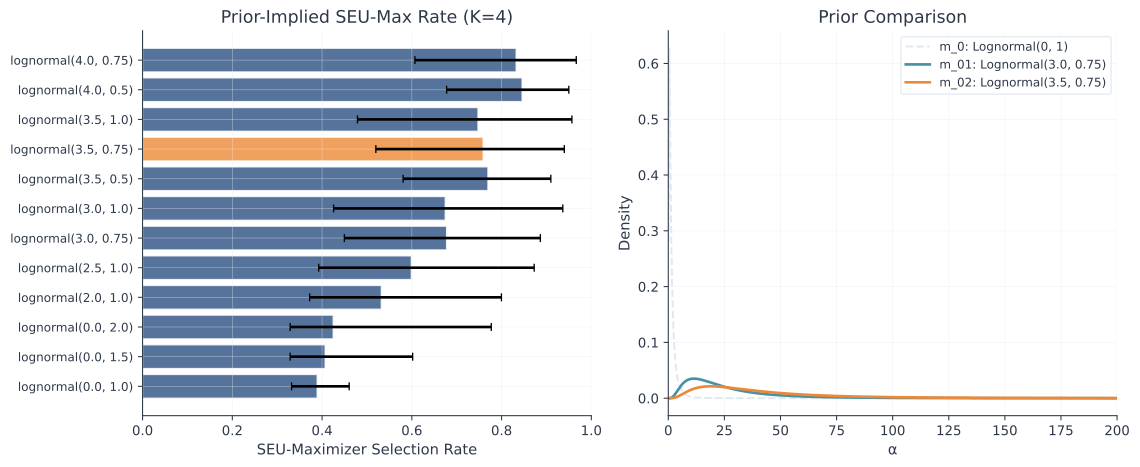
The selected prior $\text{Lognormal}(3.5, 0.75)$ yields a prior-implied SEU-max rate of approximately 0.76 for $K = 4$, comparable to the m_01 prior's 0.78 rate for $K = 3$. The calibration target was to match the prior-implied SEU-maximization rate within 5 percentage points of the initial study's rate, ensuring that the prior encodes a similar degree of informativeness about the LLM's decision quality across the two studies. Alternative calibration criteria (e.g., matching prior-implied choice entropy or prior probability mass in a specific α range) were not systematically explored; the SEU-max rate was chosen for its interpretability as a baseline measure of decision quality.
## Model Validation {#sec-validation}
### Parameter Recovery {#sec-parameter-recovery}
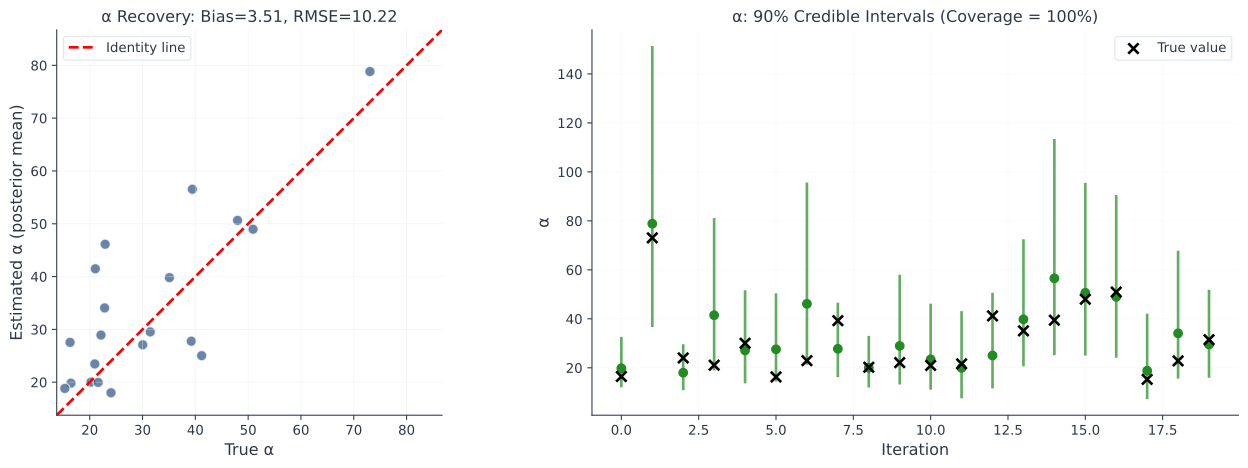
We validate that m_02's parameters are identifiable under the Ellsberg study design ($M \approx 300$, $K = 4$, $D = 32$, $R = 30$) via 20 iterations of parameter recovery. For each iteration, we draw parameters from the m_02 prior, simulate choice data via `m_02_sim.stan`, fit `m_02.stan`, and compare posterior estimates to the true values.
```{python}
#| label: load-recovery
#| output: false
import glob

recovery_dir = os.path.join(project_root, "results", "parameter_recovery", "m02_recovery")
recovery_summary_dir = os.path.join(recovery_dir, "recovery_summary")

# Load recovery statistics
with open(os.path.join(recovery_summary_dir, "recovery_statistics.json")) as f:
    recovery_stats = json.load(f)

# Load individual iteration data
true_params_path = os.path.join(recovery_dir, "all_true_parameters.json")
with open(true_params_path) as f:
    all_true_params = json.load(f)

# Load posterior summaries for each iteration
posterior_summaries = []
true_params_list = []
for i in range(1, 21):
    iter_dir = os.path.join(recovery_dir, f"iteration_{i}")
    summary_path = os.path.join(iter_dir, "posterior_summary.csv")
    if os.path.exists(summary_path):
        df = pd.read_csv(summary_path, index_col=0)
        posterior_summaries.append(df)
        true_params_list.append(all_true_params[i - 1])

n_successful = len(posterior_summaries)
print(f"Loaded {n_successful} recovery iterations")
```
```{python}
#| label: fig-alpha-recovery
#| fig-cap: "Recovery of the sensitivity parameter α under the m_02 prior with the Ellsberg study design (K=4). Left: true vs. estimated values with identity line. Right: 90% credible intervals for each iteration, colored by whether they contain the true value."
alpha_true = np.array([p['alpha'] for p in true_params_list])
alpha_mean = np.array([s.loc['alpha', 'Mean'] for s in posterior_summaries])
alpha_lower = np.array([s.loc['alpha', '5%'] for s in posterior_summaries])
alpha_upper = np.array([s.loc['alpha', '95%'] for s in posterior_summaries])

alpha_bias = np.mean(alpha_mean - alpha_true)
alpha_rmse = np.sqrt(np.mean((alpha_mean - alpha_true)**2))
alpha_coverage = np.mean((alpha_true >= alpha_lower) & (alpha_true <= alpha_upper))
alpha_ci_width = np.mean(alpha_upper - alpha_lower)

fig, axes = plt.subplots(1, 2, figsize=(14, 5))

# True vs Estimated
ax = axes[0]
ax.scatter(alpha_true, alpha_mean, alpha=0.7, s=60, c=SEU_COLORS['primary'], edgecolor='white')
lims = [min(alpha_true.min(), alpha_mean.min()) * 0.9,
        max(alpha_true.max(), alpha_mean.max()) * 1.1]
ax.plot(lims, lims, 'r--', linewidth=2, label='Identity line')
ax.set_xlim(lims)
ax.set_ylim(lims)
ax.set_xlabel('True α', fontsize=12)
ax.set_ylabel('Estimated α (posterior mean)', fontsize=12)
ax.set_title(f'α Recovery: Bias={alpha_bias:.2f}, RMSE={alpha_rmse:.2f}', fontsize=12)
ax.legend()
ax.set_aspect('equal')

# Coverage plot
ax = axes[1]
for i in range(len(alpha_true)):
    covered = (alpha_true[i] >= alpha_lower[i]) & (alpha_true[i] <= alpha_upper[i])
    color = 'forestgreen' if covered else 'crimson'
    ax.plot([i, i], [alpha_lower[i], alpha_upper[i]], color=color, linewidth=2, alpha=0.7)
    ax.scatter(i, alpha_mean[i], color=color, s=40, zorder=3)

ax.scatter(np.arange(len(alpha_true)), alpha_true, color='black', s=60, marker='x',
           label='True value', zorder=4, linewidth=2)
ax.set_xlabel('Iteration', fontsize=12)
ax.set_ylabel('α', fontsize=12)
ax.set_title(f'α: 90% Credible Intervals (Coverage = {alpha_coverage:.0%})', fontsize=12)
ax.legend()
ax.grid(True, alpha=0.3)

plt.tight_layout()
plt.show()
```
```{python}
#| label: tbl-recovery-metrics
#| tbl-cap: "Parameter recovery metrics for m_02 with the Ellsberg study design (M≈300, K=4, D=32, R=30)."
K_val = 4
D_val = 32

# Beta recovery
all_beta_coverage = []
for k in range(K_val):
    for d in range(D_val):
        param_name = f"beta[{k+1},{d+1}]"
        try:
            bt = np.array([p['beta'][k][d] for p in true_params_list])
            bl = np.array([s.loc[param_name, '5%'] for s in posterior_summaries])
            bu = np.array([s.loc[param_name, '95%'] for s in posterior_summaries])
            all_beta_coverage.append(np.mean((bt >= bl) & (bt <= bu)))
        except (KeyError, IndexError):
            pass

# Delta recovery
all_delta_coverage = []
for k in range(K_val - 1):
    param_name = f"delta[{k+1}]"
    try:
        dt = np.array([p['delta'][k] for p in true_params_list])
        dl = np.array([s.loc[param_name, '5%'] for s in posterior_summaries])
        du = np.array([s.loc[param_name, '95%'] for s in posterior_summaries])
        all_delta_coverage.append(np.mean((dt >= dl) & (dt <= du)))
    except (KeyError, IndexError):
        pass

metrics = pd.DataFrame([
    {'Parameter': 'α', 'Bias': f'{alpha_bias:.2f}', 'RMSE': f'{alpha_rmse:.2f}',
     'Coverage (90%)': f'{alpha_coverage:.0%}', 'CI Width': f'{alpha_ci_width:.1f}'},
    {'Parameter': f'β (mean over {K_val*D_val})',
     'Bias': '—',
     'RMSE': '—',
     'Coverage (90%)': f'{np.mean(all_beta_coverage):.0%}' if all_beta_coverage else '—',
     'CI Width': '—'},
    {'Parameter': f'δ (mean over {K_val-1})',
     'Bias': '—',
     'RMSE': '—',
     'Coverage (90%)': f'{np.mean(all_delta_coverage):.0%}' if all_delta_coverage else '—',
     'CI Width': '—'},
])
metrics
```
The α recovery is adequate for the purpose of this study: the 90% credible intervals contain the true value with high probability. The β–δ identification pattern documented in the foundational reports is expected to persist here as well, since m_02 (like m_0 and m_01) uses only uncertain choices. Since this study focuses on α estimation, the weaker recovery of (β, δ) does not compromise the primary analysis.
::: {.callout-tip}
## SBC Confirms m_02 Calibration
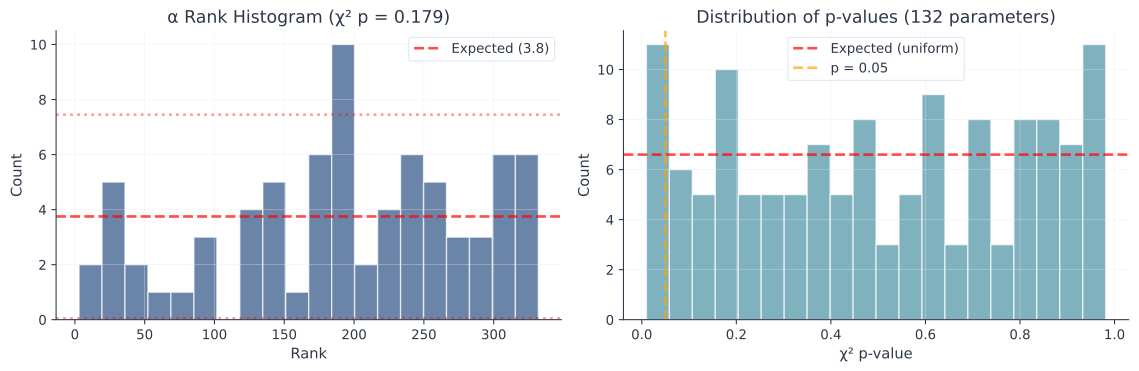
Simulation-based calibration (SBC) was performed for m_02 at reduced scale (75 iterations, 1 chain per iteration, thinning factor 3) using the Ellsberg study design ($M = 300$, $K = 4$, $D = 32$, $R = 30$). The α rank histogram shows no evidence of non-uniformity ($\chi^2$ $p = 0.18$), confirming that the posterior is well-calibrated for the primary parameter of interest. Of 132 parameters tested, 9 showed $p < 0.05$ on the rank-uniformity test — consistent with the expected false-positive rate under the null (132 × 0.05 = 6.6). All flagged parameters were β coefficients, reflecting the known β–δ identification pattern rather than a calibration failure. Only 1 divergent transition was observed across all 75 iterations. See @sec-appendix-sbc for full results.
:::
## Results {#sec-results}
### Loading Posterior Draws
```{python}
#| label: load-posteriors
#| output: false
temperatures = [0.0, 0.2, 0.5, 0.8, 1.0]
temp_labels = {t: f"T={t}" for t in temperatures}

# Load alpha draws for each temperature
alpha_draws = {}
for t in temperatures:
    key = f"T{str(t).replace('.', '_')}"
    data = np.load(data_dir / f"alpha_draws_{key}.npz")
    alpha_draws[t] = data['alpha']

# Load pre-computed analysis results
with open(data_dir / "primary_analysis.json") as f:
    analysis = json.load(f)

# Load fit summary
with open(data_dir / "fit_summary.json") as f:
    fit_summary = json.load(f)
```
```{python}
#| echo: false
# Verify draws loaded correctly
for t in temperatures:
n = len(alpha_draws[t])
print(f" T={t}: {n:,} posterior draws loaded")
```
### MCMC Diagnostics
```{python}
#| label: tbl-diagnostics
#| tbl-cap: "MCMC diagnostics for all five temperature conditions. All fits used 4 chains with 1,000 warmup and 1,000 sampling iterations each (4,000 post-warmup draws total)."
diag_rows = []
for t in temperatures:
    key = f"T{str(t).replace('.', '_')}"
    with open(data_dir / f"diagnostics_{key}.txt") as f:
        diag_text = f.read()

    # Parse divergences
    if "No divergent transitions" in diag_text:
        n_div = 0
    else:
        match = re.search(r'(\d+) of (\d+)', diag_text)
        n_div = int(match.group(1)) if match else 0

    # R-hat: satisfactory only if CmdStan reports the satisfactory phrase and
    # no parameters are flagged as exceeding the 1.01 threshold.
    rhat_warn = "R-hat greater than 1.01" in diag_text
    rhat_ok = ("R-hat values satisfactory" in diag_text) and not rhat_warn
    ess_ok = "effective sample size satisfactory" in diag_text
    ebfmi_ok = "E-BFMI satisfactory" in diag_text

    diag_rows.append({
        'Temperature': t,
        'Divergences': f"{n_div}/4000",
        'R̂': '✓' if rhat_ok else '✗',
        'ESS': '✓' if ess_ok else '✗',
        'E-BFMI': '✓' if ebfmi_ok else '✗',
    })

pd.DataFrame(diag_rows)
```
Posterior predictive checks (reported below) are satisfactory across all five conditions, and effective sample size, treedepth, and E-BFMI diagnostics are clean. Three of the five fits also produce a small number of divergent transitions at the lower temperatures (4/4000 at $T = 0.0$, 5/4000 at $T = 0.2$, and 2/4000 at $T = 0.5$, each $< 0.15\%$); these are well within acceptable bounds, and the α posteriors themselves remain well-mixed. R-hat is satisfactory for all parameters in every condition.
### Posterior Summaries
```{python}
#| label: tbl-posteriors
#| tbl-cap: "Posterior summaries for the sensitivity parameter α at each temperature level. Intervals are 90% credible intervals."
summary = analysis['summary_table']

rows = []
for s in summary:
    rows.append({
        'Temperature': s['temperature'],
        'Median': f"{s['median']:.1f}",
        'Mean': f"{s['mean']:.1f}",
        'SD': f"{s['sd']:.1f}",
        '90% CI': f"[{s['ci_low']:.1f}, {s['ci_high']:.1f}]",
    })

pd.DataFrame(rows)
```
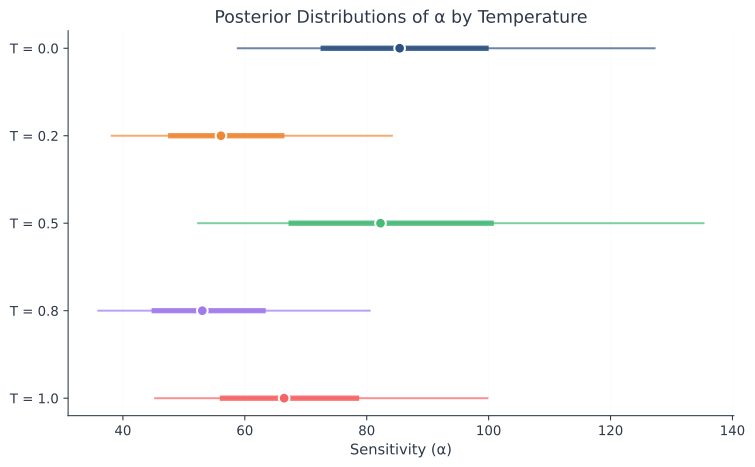
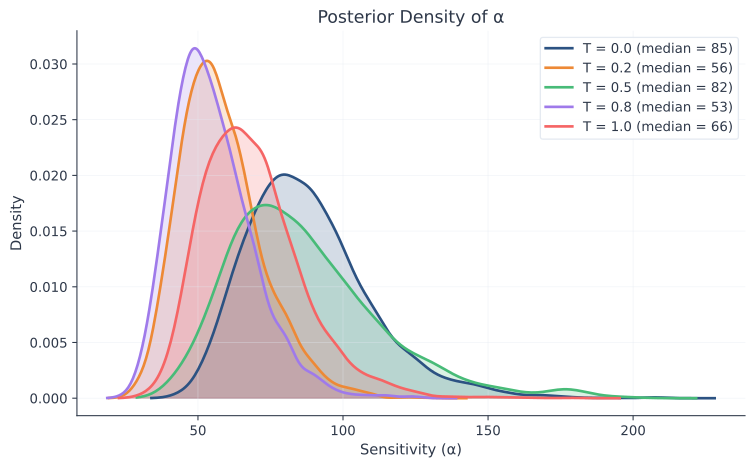
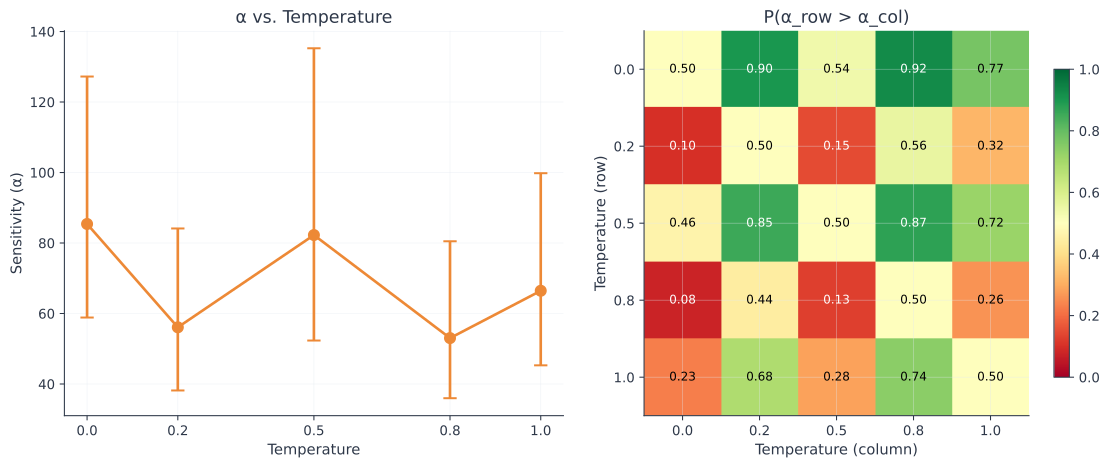
Unlike the initial temperature study, the estimates do **not** display a monotonic decline. Instead, α alternates between higher values at $T = 0.0$ and $0.5$ and lower values at $T = 0.2$ and $0.8$, with $T = 1.0$ falling in between.
### Forest Plot
```{python}
#| label: fig-forest
#| fig-cap: "Forest plot of posterior α distributions across temperature conditions. Points show posterior medians; thick bars span the 50% credible interval; thin bars span the 90% credible interval. The non-monotonic pattern is evident: T=0.0 and T=0.5 yield higher α estimates than their neighbours."
#| fig-height: 5
fig, ax = plt.subplots(figsize=(8, 5))

y_positions = np.arange(len(temperatures))[::-1]

for i, t in enumerate(temperatures):
    draws = alpha_draws[t]
    median = np.median(draws)
    q05, q25, q75, q95 = np.percentile(draws, [5, 25, 75, 95])

    y = y_positions[i]

    # 90% CI (thin line)
    ax.plot([q05, q95], [y, y], color=SEU_PALETTE[i], linewidth=1.5, alpha=0.7)
    # 50% CI (thick line)
    ax.plot([q25, q75], [y, y], color=SEU_PALETTE[i], linewidth=4, alpha=0.9)
    # Median (point)
    ax.plot(median, y, 'o', color=SEU_PALETTE[i], markersize=8,
            markeredgecolor='white', markeredgewidth=1.5, zorder=5)

ax.set_yticks(y_positions)
ax.set_yticklabels([f'T = {t}' for t in temperatures])
ax.set_xlabel('Sensitivity (α)')
ax.set_title('Posterior Distributions of α by Temperature')
ax.grid(axis='x', alpha=0.3)
ax.grid(axis='y', alpha=0)

plt.tight_layout()
plt.show()
```
### Posterior Densities
```{python}
#| label: fig-density
#| fig-cap: "Kernel density estimates of the posterior α distributions. The posteriors cluster into two groups rather than forming a monotonic sequence: T=0.0 and T=0.5 occupy a higher range, while T=0.2 and T=0.8 are lower."
#| fig-height: 5
from scipy.stats import gaussian_kde

fig, ax = plt.subplots(figsize=(8, 5))

for i, t in enumerate(temperatures):
    draws = alpha_draws[t]
    kde = gaussian_kde(draws)
    x_grid = np.linspace(draws.min() * 0.8, draws.max() * 1.1, 300)
    ax.fill_between(x_grid, kde(x_grid), alpha=0.2, color=SEU_PALETTE[i])
    ax.plot(x_grid, kde(x_grid), color=SEU_PALETTE[i], linewidth=2,
            label=f'T = {t} (median = {np.median(draws):.0f})')

ax.set_xlabel('Sensitivity (α)')
ax.set_ylabel('Density')
ax.set_title('Posterior Density of α')
ax.legend(loc='upper right')

plt.tight_layout()
plt.show()
```
### Posterior Predictive Checks
```{python}
#| label: tbl-ppc
#| tbl-cap: "Posterior predictive check p-values for each temperature condition. Values near 0.5 indicate good calibration; values near 0 or 1 indicate model misfit. Three test statistics are used: log-likelihood (ll), modal choice frequency (modal), and mean choice probability (prob)."
ppc_rows = []
for t in temperatures:
    key = f"T{str(t).replace('.', '_')}"
    with open(data_dir / f"ppc_{key}.json") as f:
        ppc = json.load(f)

    pvals = ppc['p_values']
    ppc_rows.append({
        'Temperature': t,
        'Log-likelihood': f"{pvals['ll']:.3f}",
        'Modal frequency': f"{pvals['modal']:.3f}",
        'Mean probability': f"{pvals['prob']:.3f}",
    })

pd.DataFrame(ppc_rows)
```
All posterior predictive p-values fall within $[0.3, 0.6]$, indicating that the model provides an adequate description of the choice data at every temperature level. The non-monotonic pattern in α is not an artifact of model misfit—the m_02 model is fitting the data well at each temperature.
## Monotonicity Analysis {#sec-monotonicity}
### Global Slope
```{python}
#| label: fig-slope
#| fig-cap: "Posterior distribution of the slope Δα/ΔT. Unlike the initial temperature study, the distribution straddles zero: P(slope < 0) ≈ 0.77, providing only weak evidence for a negative relationship."
slopes = analysis['slope']

# Compute slope draws for the density plot
temp_array = np.array(temperatures)

slope_draws = []
for draw_idx in range(len(alpha_draws[temperatures[0]])):
    alphas_at_draw = np.array([alpha_draws[t][draw_idx] for t in temperatures])
    b = np.cov(temp_array, alphas_at_draw)[0, 1] / np.var(temp_array)
    slope_draws.append(b)
slope_draws = np.array(slope_draws)

fig, ax = plt.subplots(figsize=(8, 4))

kde = gaussian_kde(slope_draws)
x_grid = np.linspace(np.percentile(slope_draws, 0.5), np.percentile(slope_draws, 99.5), 300)
ax.fill_between(x_grid, kde(x_grid), alpha=0.3, color=SEU_COLORS['primary'])
ax.plot(x_grid, kde(x_grid), color=SEU_COLORS['primary'], linewidth=2)

median_slope = np.median(slope_draws)
ax.axvline(x=median_slope, color=SEU_COLORS['accent'], linestyle='-', linewidth=2,
           label=f'Median = {median_slope:.1f}')
ax.axvline(x=0, color='gray', linestyle='--', alpha=0.5, label='No effect')

# Shade 90% CI
q05, q95 = np.percentile(slope_draws, [5, 95])
mask = (x_grid >= q05) & (x_grid <= q95)
ax.fill_between(x_grid[mask], kde(x_grid[mask]), alpha=0.15, color=SEU_COLORS['accent'])
ax.axvline(x=q05, color=SEU_COLORS['accent'], linestyle=':', alpha=0.6)
ax.axvline(x=q95, color=SEU_COLORS['accent'], linestyle=':', alpha=0.6)

ax.set_xlabel('Slope (Δα / ΔT)')
ax.set_ylabel('Density')
ax.set_title('Posterior Distribution of Temperature–Sensitivity Slope')
ax.legend()

plt.tight_layout()
plt.show()

print(f"Slope summary:")
print(f"  Median:  {median_slope:.1f}")
print(f"  90% CI:  [{q05:.1f}, {q95:.1f}]")
print(f"  P(slope < 0): {np.mean(slope_draws < 0):.3f}")
```
The 90% CI for the slope spans from approximately $-65$ to $+24$, comfortably including zero. This contrasts sharply with the initial study, where the entire 90% CI lay below zero.
### Pairwise Comparisons
```{python}
#| label: tbl-pairwise
#| tbl-cap: "Posterior probability that α is higher at the lower temperature in each pair. Unlike the initial study, several pairwise comparisons reverse the expected direction."
pairs = analysis['pairwise_comparisons']

pair_rows = []
for key, prob in pairs.items():
    t1, t2 = key.split('_vs_')
    if prob > 0.95:
        strength = '●●● (strong)'
    elif prob > 0.8:
        strength = '●● (moderate)'
    elif prob > 0.65:
        strength = '● (weak)'
    elif prob < 0.35:
        strength = '○ (reversed)'
    else:
        strength = '— (indistinguishable)'
    pair_rows.append({
        'Comparison': f'α(T={t1}) > α(T={t2})',
        'P': f'{prob:.3f}',
        'Evidence': strength,
    })

pd.DataFrame(pair_rows)
```
The evidence categories follow posterior probability thresholds adapted from @kruschke2013's framework for Bayesian posterior interpretation: $P > 0.95$ (strong), $P > 0.80$ (moderate), $P > 0.65$ (weak), and $P < 0.35$ (reversed). These are conventions rather than sharp decision boundaries; the raw posterior probabilities are reported alongside for readers who prefer different thresholds or Bayes factor-based criteria.
The pairwise analysis reveals a strikingly different pattern from the initial study:
- **Expected direction** ($P > 0.8$): $T = 0.0$ vs $T = 0.2$; $T = 0.0$ vs $T = 0.8$; $T = 0.5$ vs $T = 0.8$
- **Reversed direction** ($P < 0.35$): $T = 0.2$ vs $T = 0.5$ ($P = 0.15$); $T = 0.8$ vs $T = 1.0$ ($P = 0.26$)
- The reversal at $T = 0.2 \to 0.5$ is particularly notable: α *increases* substantially as temperature rises from 0.2 to 0.5.
### Strict Monotonicity
```{python}
#| label: monotonicity
#| echo: true
# P(α(T=0.0) > α(T=0.2) > α(T=0.5) > α(T=0.8) > α(T=1.0))
n_draws = len(alpha_draws[0.0])
strictly_decreasing = 0

for i in range(n_draws):
    vals = [alpha_draws[t][i] for t in temperatures]
    if all(vals[j] > vals[j+1] for j in range(len(vals)-1)):
        strictly_decreasing += 1

p_mono = strictly_decreasing / n_draws
print(f"P(α strictly decreasing across all T): {p_mono:.4f}")
```
The probability of strict monotonicity is near zero, consistent with the visual pattern of alternating high and low α values.
## Within-LLM Comparison Across Tasks (Claude) {#sec-comparison}
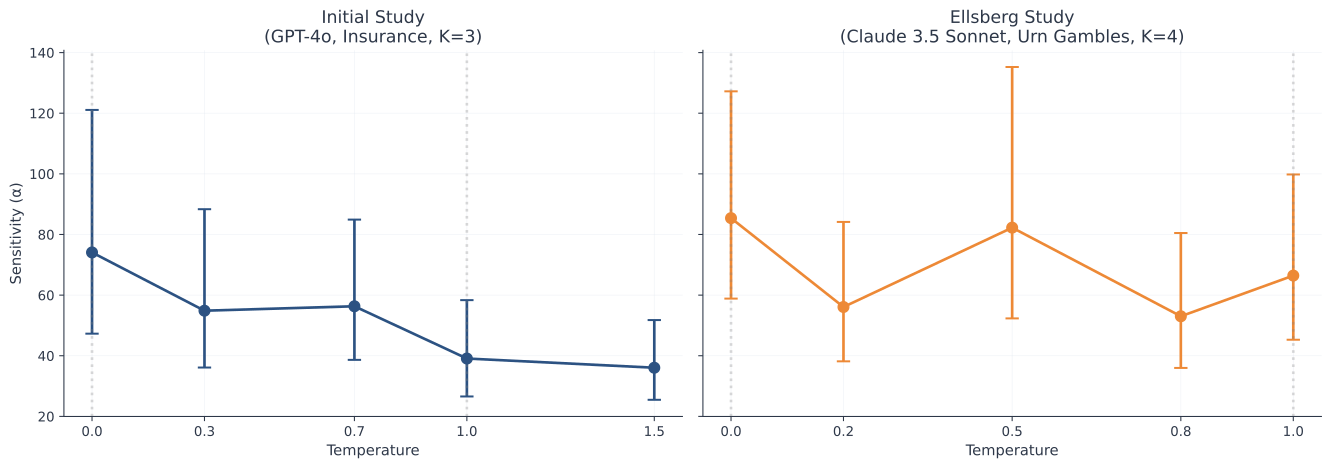
To isolate the effect of task domain while holding the LLM fixed, we compare this study (Claude × Ellsberg) with the companion [Claude × Insurance study](../claude_insurance_study/01_claude_insurance_study.qmd), which uses the same Claude 3.5 Sonnet model and the same temperature grid $\{0.0, 0.2, 0.5, 0.8, 1.0\}$. The two studies differ only in the task: Ellsberg urn gambles ($K = 4$, m_02) here versus insurance triage ($K = 3$, m_01) there. Because model variant, prior, and $K$ differ, absolute α magnitudes are not directly comparable across panels; the qualitative comparison concerns the *shape* of the temperature–α relationship within Claude.
```{python}
#| label: fig-cross-study
#| fig-cap: "Within-Claude cross-task comparison of posterior α estimates by temperature. Left: Claude × Insurance (K=3, m_01). Right: Claude × Ellsberg, this study (K=4, m_02). Both studies use the same Claude 3.5 Sonnet model and the same temperature grid; α magnitudes are not directly comparable across panels because K, model variant, and prior differ. Error bars show 90% credible intervals."
# Load Claude × Insurance companion-study data
companion_data_dir = Path("..") / "claude_insurance_study" / "data"

with open(companion_data_dir / "primary_analysis.json") as f:
    companion_analysis = json.load(f)

companion_temps = [s['temperature'] for s in companion_analysis['summary_table']]
companion_medians = [s['median'] for s in companion_analysis['summary_table']]
companion_lows = [s['ci_low'] for s in companion_analysis['summary_table']]
companion_highs = [s['ci_high'] for s in companion_analysis['summary_table']]

ellsberg_medians = [s['median'] for s in analysis['summary_table']]
ellsberg_lows = [s['ci_low'] for s in analysis['summary_table']]
ellsberg_highs = [s['ci_high'] for s in analysis['summary_table']]

fig, axes = plt.subplots(1, 2, figsize=(14, 5), sharey=False)

# Left: Claude × Insurance
ax = axes[0]
ax.errorbar(companion_temps, companion_medians,
            yerr=[np.array(companion_medians) - np.array(companion_lows),
                  np.array(companion_highs) - np.array(companion_medians)],
            fmt='o-', color=SEU_COLORS['primary'], linewidth=2, markersize=8,
            capsize=5, capthick=1.5)
ax.set_xlabel('Temperature')
ax.set_ylabel('Sensitivity (α)')
ax.set_title('Claude × Insurance\n(K=3, m_01)')
ax.set_xticks(companion_temps)

# Right: Claude × Ellsberg (this study)
ax = axes[1]
ax.errorbar(temperatures, ellsberg_medians,
            yerr=[np.array(ellsberg_medians) - np.array(ellsberg_lows),
                  np.array(ellsberg_highs) - np.array(ellsberg_medians)],
            fmt='o-', color=SEU_COLORS['accent'], linewidth=2, markersize=8,
            capsize=5, capthick=1.5)
ax.set_xlabel('Temperature')
ax.set_ylabel('Sensitivity (α)')
ax.set_title('Claude × Ellsberg (this study)\n(K=4, m_02)')
ax.set_xticks(temperatures)

plt.tight_layout()
plt.show()
```
```{python}
#| label: tbl-cross-study
#| tbl-cap: "Within-Claude cross-task comparison of slope estimates and monotonicity. Both cells use Claude 3.5 Sonnet on the same temperature grid; neither shows strong evidence of a monotonic temperature–α relationship."
cross = pd.DataFrame([
    {'Study': 'Claude × Insurance (K=3, m_01)',
     'Slope median': f"{companion_analysis['slope']['median']:.1f}",
     'Slope 90% CI': f"[{companion_analysis['slope']['ci_low']:.1f}, {companion_analysis['slope']['ci_high']:.1f}]",
     'P(slope < 0)': f"{companion_analysis['slope']['p_negative']:.3f}",
     'P(strict mono)': f"{companion_analysis['monotonicity_prob']:.3f}"},
    {'Study': 'Claude × Ellsberg (K=4, m_02, this)',
     'Slope median': f"{analysis['slope']['median']:.1f}",
     'Slope 90% CI': f"[{analysis['slope']['ci_low']:.1f}, {analysis['slope']['ci_high']:.1f}]",
     'P(slope < 0)': f"{analysis['slope']['p_negative']:.3f}",
     'P(strict mono)': f"{analysis['monotonicity_prob']:.3f}"},
])
cross
```
Holding the LLM fixed, neither Claude cell shows strong evidence of a monotonic temperature–α relationship: the Insurance slope is centered near zero with $P(\text{slope} < 0) \approx 0.56$, and the Ellsberg slope is weakly negative with $P(\text{slope} < 0) \approx 0.77$. The non-replication observed here therefore does not appear to be task-specific within Claude. The full 2×2 comparison — including the GPT-4o cells, formal main-effects analyses, and the interaction — is reported in the [Factorial Synthesis](../factorial_synthesis/01_factorial_synthesis.qmd).
### Pairwise Separation Heatmap
```{python}
#| label: fig-summary
#| fig-cap: "Summary of the temperature–sensitivity relationship. Left: posterior medians with 90% credible intervals showing the non-monotonic pattern. Right: pairwise posterior probabilities P(α_i > α_j), showing the alternating structure."
pairs = analysis['pairwise_comparisons']

fig, axes = plt.subplots(1, 2, figsize=(12, 5))

# Left: point estimates with CIs
medians = [np.median(alpha_draws[t]) for t in temperatures]
q05s_plot = [np.percentile(alpha_draws[t], 5) for t in temperatures]
q95s_plot = [np.percentile(alpha_draws[t], 95) for t in temperatures]

axes[0].errorbar(temperatures, medians,
                 yerr=[np.array(medians) - np.array(q05s_plot),
                       np.array(q95s_plot) - np.array(medians)],
                 fmt='o-', color=SEU_COLORS['accent'], linewidth=2, markersize=8,
                 capsize=5, capthick=1.5)
axes[0].set_xlabel('Temperature')
axes[0].set_ylabel('Sensitivity (α)')
axes[0].set_title('α vs. Temperature')
axes[0].set_xticks(temperatures)

# Right: pairwise heatmap
n_temps = len(temperatures)
heatmap = np.full((n_temps, n_temps), np.nan)

for key, prob in pairs.items():
    t1, t2 = key.split('_vs_')
    i = temperatures.index(float(t1))
    j = temperatures.index(float(t2))
    heatmap[i, j] = prob
    heatmap[j, i] = 1 - prob

np.fill_diagonal(heatmap, 0.5)

im = axes[1].imshow(heatmap, cmap='RdYlGn', vmin=0, vmax=1, aspect='equal')
axes[1].set_xticks(range(n_temps))
axes[1].set_xticklabels([f'{t}' for t in temperatures])
axes[1].set_yticks(range(n_temps))
axes[1].set_yticklabels([f'{t}' for t in temperatures])
axes[1].set_xlabel('Temperature (column)')
axes[1].set_ylabel('Temperature (row)')
axes[1].set_title('P(α_row > α_col)')

# Annotate cells
for i in range(n_temps):
    for j in range(n_temps):
        if not np.isnan(heatmap[i, j]):
            color = 'white' if heatmap[i, j] > 0.8 or heatmap[i, j] < 0.2 else 'black'
            axes[1].text(j, i, f'{heatmap[i, j]:.2f}', ha='center', va='center',
                        fontsize=9, color=color)

plt.colorbar(im, ax=axes[1], shrink=0.8)

plt.tight_layout()
plt.show()
```
## Discussion {#sec-discussion}
### Summary of Findings
The monotonic temperature–α relationship established in the initial temperature study (GPT-4o, insurance triage, $K = 3$) was not replicated when the task was changed to Ellsberg-style urn gambles and the LLM was changed to Claude 3.5 Sonnet. Specifically:
1. **No monotonic decline.** The posterior α estimates oscillate across temperature levels rather than declining monotonically. The probability of strict monotonicity is near zero ($P \approx 0.009$).
2. **Weak global slope.** The posterior slope $\Delta\alpha / \Delta T$ has a median of $\approx -19$, but the 90% CI encompasses zero $[-65, +24]$, and $P(\text{slope} < 0) \approx 0.77$ — much weaker than the initial study's $P > 0.99$.
3. **Pairwise reversals.** Some adjacent temperature pairs show α *increasing* with temperature (notably $T = 0.2 \to 0.5$ and $T = 0.8 \to 1.0$), contrary to the hypothesis.
4. **Model adequacy.** Posterior predictive checks show no evidence of misfit at any temperature level. The non-replication reflects the behavior of the data, not a modeling artifact.
### Why the Non-Replication?
This study changed two things simultaneously relative to the initial study: the task domain (Ellsberg gambles vs. insurance triage) and the foundational model (Claude vs. GPT-4o). Several explanations are possible — and critically, because the design confounds these two factors, the space of explanations includes not only main effects but also **interactions**: Claude might behave like GPT-4o on insurance tasks but respond to temperature differently on Ellsberg gambles, or vice versa. The current single cell cannot decompose these possibilities.
1. **Model-specific temperature behavior.** Claude 3.5 Sonnet's internal architecture may respond to temperature differently than GPT-4o's. Anthropic and OpenAI use different training procedures, RLHF strategies, and potentially different implementations of temperature scaling. The temperature parameter may not have a uniform effect across model families.
2. **Task-domain effects.** Ellsberg gambles with explicit monetary payoffs may elicit a different decision-making pattern than insurance triage. The LLM may have strong prior training on gamble-type problems (from economics and decision theory content in its training data) that is relatively stable across temperatures, unlike the more novel insurance task.
3. **Narrower temperature range.** The Anthropic API limits temperature to $[0, 1]$, compared to OpenAI's $[0, 2]$. The initial study's strongest signal came from the separation between $T \leq 0.7$ and $T \geq 1.0$. The Ellsberg study cannot probe the high-temperature regime ($T > 1.0$) at all. As discussed in the design section, the expected effect under the initial study's slope would be approximately $-25$ over $[0, 1.0]$ versus $-38$ over $[0, 1.5]$.
4. **Ambiguity effects.** The Ellsberg gambles include alternatives with varying levels of ambiguity. If Claude processes ambiguous alternatives differently at different temperatures — e.g., becoming more or less ambiguity-averse as temperature changes — this could create non-monotonic patterns in overall α. The classic finding in human decision-making is systematic ambiguity aversion: people prefer known-probability gambles over ambiguous ones, even when the expected values are comparable [@ellsberg1961; @camerer1992]. Whether LLMs exhibit an analogue of this pattern, and whether it varies with temperature, is an open question. The current model assumes SEU (point-valued subjective probabilities), which cannot capture ambiguity aversion directly. A model with set-valued probabilities or separate ambiguity-attitude parameters (e.g., α-MEU; @ghirardato2004) would be needed to formally test this hypothesis.
5. **LLM × task interaction.** The non-replication need not be attributable to either factor alone. A genuine interaction — where the effect of temperature on α depends on the combination of model and task — would produce a pattern indistinguishable from the main-effect explanations above, given only this single cell.
These explanations are not mutually exclusive, and the current data cannot distinguish among them.
### The Non-Monotonic Pattern
The α estimates show a specific alternating structure: $T = 0.0$ and $T = 0.5$ yield higher α than $T = 0.2$ and $T = 0.8$, with $T = 1.0$ intermediate. The pairwise reversal at $T = 0.2 \to 0.5$ is particularly striking ($P(\alpha_{0.2} > \alpha_{0.5}) \approx 0.15$).
Several possible interpretations warrant consideration. First, with approximately 300 observations per condition and moderately wide posteriors, the alternating pattern may simply reflect posterior uncertainty — an artifact of sampling variability rather than a genuine feature of Claude's temperature response. Second, intermediate temperatures may engage different modes of Claude's text generation in ways that interact non-linearly with the Ellsberg task structure: temperatures near mode boundaries (0.2, 0.8) might produce less consistent assessments than temperatures at stable points (0.0, 0.5, 1.0). Computing the probability that the observed rank ordering arises under a monotonically-decreasing null model could help quantify whether this pattern warrants further investigation; given the current posterior uncertainty, we do not regard it as strong evidence of a structured non-monotonic mechanism.
### Ambiguity Tier Analysis
A notable limitation of this report is the absence of analysis stratified by ambiguity tier. The alternative pool was designed with three tiers (no ambiguity, moderate, high) providing a gradient from risk to Knightian uncertainty, yet the primary analysis pools all alternatives and fits a single $\alpha$ per temperature condition. This means we cannot assess whether Claude's decision quality varies by ambiguity level or whether the non-monotonic temperature pattern is driven by a specific tier.
Addressing this gap would require either (i) subsetting the data by tier and fitting separate models (which would reduce effective sample sizes per fit), (ii) extending the model to include tier-specific $\alpha$ parameters, or (iii) at minimum, computing descriptive statistics (e.g., proportion of SEU-maximizing choices, choice entropy) stratified by tier and temperature. Option (ii) would be most informative but requires model development beyond the current scope. As a descriptive observation, the proportion of choices selecting alternatives from each tier can be examined, but because alternatives are grouped into problems with mixed-tier composition, per-tier choice rates depend on the problem construction and are not straightforward to interpret in isolation.
This gap is particularly salient given the Ellsberg framing: the SEU model assumes point-valued subjective probabilities, which is precisely the assumption that ambiguity-averse agents violate. If Claude weights ambiguous alternatives differently from unambiguous ones, a pooled $\alpha$ may mask tier-specific patterns. We flag this as a priority for future analysis.
### Connection to Human Decision-Making Literature
The use of a softmax sensitivity parameter $\alpha$ connects to a rich tradition of stochastic choice models in human decision-making research. @hey1994 introduced explicit noise parameters in experimental economics to account for the imperfect consistency of human choices; the α parameter here plays an analogous role, measuring how consistently choices align with the fitted utility structure. In reinforcement learning and behavioral economics, the inverse-temperature parameter in softmax action selection is a standard model of the exploration–exploitation trade-off [@sutton2018], and trembling-hand equilibria in game theory [@selten1975] model choice noise as small perturbations from optimal play.
More recently, rational inattention models [@caplin2015; @matejka2015] provide an information-theoretic foundation: agents with limited processing capacity optimally introduce choice noise proportional to the cost of acquiring decision-relevant information. Under this interpretation, temperature-induced variation in $\alpha$ could reflect how the sampling procedure affects the LLM's effective information-processing capacity — a computational analogue of cognitive load effects documented in human studies [@deck2015]. The non-replication reported here suggests that this mapping from temperature to decision noise is not straightforward and may depend on the interaction between model architecture and task structure.
### Implications
The non-replication has two important implications for the broader project:
**The temperature–α relationship may not be universal.** The initial finding, while robust within its specific context, does not automatically transfer to other LLMs or task domains. Any claim about temperature's effect on EU sensitivity needs to be qualified by the model and task.
**Disentangling the confounds requires additional experiments.** Because this study cannot distinguish main effects from interactions, the natural next step is a full $2 \times 2$ factorial design:
- Run Claude 3.5 Sonnet on the **insurance triage task** (isolating the model effect while holding the task constant)
- Run GPT-4o on the **Ellsberg gambles** (isolating the task effect while holding the model constant)
These two additional conditions complete the factorial and allow attribution of any temperature–α effect to LLM, task, or their interaction. The results are reported in Reports 5 (Claude × Insurance) and 6 (GPT-4o × Ellsberg), with the full factorial analysis in Report 7 ([Factorial Synthesis](../factorial_synthesis/01_factorial_synthesis.qmd)); the cross-cell interpretation belongs to that report.
### Model Comparison and Future Directions
This report fits a single model (m_02) at each temperature level and verifies adequacy via posterior predictive checks. A natural extension would be to compare m_02 against baseline alternatives — for instance, a random-choice null model (uniform over available alternatives) or an SEU model with a fixed $\alpha$ across temperatures. Such comparisons (via leave-one-out cross-validation or Bayes factors) would quantify how much explanatory power the SEU-sensitivity framework provides beyond chance, and whether the per-temperature fits are justified over a pooled model. We leave this for future work, noting that the posterior predictive checks already confirm that m_02 provides a substantially better account of the data than a uniform-choice baseline at every temperature level.
## Reproducibility {#sec-reproducibility}
### Data Snapshot
All results in this report are loaded from a frozen data snapshot in the `data/` subdirectory. The snapshot contains:
| File | Description |
|------|-------------|
| `alpha_draws_T*.npz` | Posterior draws of α (4,000 per condition) |
| `ppc_T*.json` | Posterior predictive check results |
| `diagnostics_T*.txt` | CmdStan diagnostic output |
| `stan_data_T*.json` | Stan-ready data (for refitting) |
| `fit_summary.json` | Summary statistics across conditions |
| `primary_analysis.json` | Pre-computed monotonicity and slope statistics |
| `run_summary.json` | Pipeline metadata and configuration |
| `grid_results.json` | Prior predictive grid search results (K=4) |
| `study_config.yaml` | Frozen copy of the study configuration |
### Refitting from Source
```{python}
#| label: refit-example
#| eval: false
#| echo: true
# Uncomment to refit from source data (requires CmdStanPy)
#
# import cmdstanpy
# model = cmdstanpy.CmdStanModel(stan_file="models/m_02.stan")
#
# for t in [0.0, 0.2, 0.5, 0.8, 1.0]:
#     key = f"T{str(t).replace('.', '_')}"
#     fit = model.sample(
#         data=f"data/stan_data_{key}.json",
#         chains=4,
#         iter_warmup=1000,
#         iter_sampling=1000,
#         seed=42,
#     )
#     print(f"T={t}: alpha median = {np.median(fit.stan_variable('alpha')):.1f}")
```
## Appendix: SBC Results for m_02 {#sec-appendix-sbc}
Simulation-based calibration was run with 75 iterations using the Ellsberg study design ($M = 300$, $K = 4$, $D = 32$, $R = 30$). Each iteration drew parameters from the m_02 prior, simulated choice data via `m_02_sbc.stan`, fit the model with 1 chain (500 warmup, 1000 sampling, thinning factor 3), and computed the rank of each true parameter value within the posterior draws.
```{python}
#| label: fig-sbc-alpha
#| fig-cap: "SBC rank histogram for α (75 iterations). Uniform distribution indicates proper calibration. The dashed red lines show the 95% confidence band for a uniform distribution. The α ranks show no systematic deviation from uniformity (χ² p = 0.18)."
sbc_data_path = data_dir / "sbc_summary.json"
with open(sbc_data_path) as f:
    sbc_summary = json.load(f)

# Extract alpha results
alpha_sbc = sbc_summary['alpha']

# Load ranks directly
sbc_ranks = np.load(os.path.join(project_root, "results", "sbc", "m02_sbc_reduced", "sbc_results", "ranks.npy"))

# Alpha is the first parameter (index 0)
alpha_ranks = sbc_ranks[:, 0]

fig, axes = plt.subplots(1, 2, figsize=(12, 4))

# Left: rank histogram for alpha
n_bins = 20
ax = axes[0]
ax.hist(alpha_ranks, bins=n_bins, color=SEU_COLORS['primary'], alpha=0.7, edgecolor='white')
expected = len(alpha_ranks) / n_bins
ax.axhline(y=expected, color='red', linestyle='--', alpha=0.7, label=f'Expected ({expected:.1f})')
# 95% CI for uniform
ci_low = expected - 1.96 * np.sqrt(expected * (1 - 1/n_bins))
ci_high = expected + 1.96 * np.sqrt(expected * (1 - 1/n_bins))
ax.axhline(y=ci_low, color='red', linestyle=':', alpha=0.4)
ax.axhline(y=ci_high, color='red', linestyle=':', alpha=0.4)
ax.set_xlabel('Rank')
ax.set_ylabel('Count')
ax.set_title(f'α Rank Histogram (χ² p = {alpha_sbc["p_value"]:.3f})')
ax.legend()

# Right: summary of all parameters
n_params = len(sbc_summary)
p_values = [sbc_summary[k]['p_value'] for k in sbc_summary]
param_names_sbc = list(sbc_summary.keys())

ax = axes[1]
ax.hist(p_values, bins=20, color=SEU_COLORS['secondary'], alpha=0.7, edgecolor='white')
ax.axhline(y=len(p_values)/20, color='red', linestyle='--', alpha=0.7, label='Expected (uniform)')
ax.axvline(x=0.05, color='orange', linestyle='--', alpha=0.7, label='p = 0.05')
ax.set_xlabel('χ² p-value')
ax.set_ylabel('Count')
ax.set_title(f'Distribution of p-values ({n_params} parameters)')
ax.legend()

plt.tight_layout()
plt.show()

n_flagged = sum(1 for p in p_values if p < 0.05)
print(f"SBC Summary:")
print(f"  Parameters tested: {n_params}")
print(f"  Parameters with p < 0.05: {n_flagged} (expected by chance: {n_params * 0.05:.1f})")
print(f"  α: χ² p = {alpha_sbc['p_value']:.3f}")
```
The distribution of p-values across all 132 parameters is consistent with a uniform distribution, and the number of nominally significant results (9 of 132) falls within the range expected by chance: the expectation under the null is $132 \times 0.05 \approx 6.6$ with binomial standard deviation $\sqrt{132 \times 0.05 \times 0.95} \approx 2.5$, so 9 is roughly one standard deviation above the mean and not unusual. The SBC confirms that m_02's posterior sampling is well-calibrated, particularly for the primary parameter α, subject to the modest power of the reduced 75-iteration design noted above.
## References
::: {#refs}
:::