---
title: "Hierarchical Implementation: The h_m01 Stan Model"
subtitle: "Foundational Report 9"
description: |
Concrete implementation of the hierarchical SEU sensitivity model in Stan.
Details the data structure, non-centered parameterization, cell-specific
belief formation, and generated quantities for model checking.
categories: [foundations, implementation, h_m01]
execute:
cache: true
---
```{python}
#| label: setup
#| include: false
import sys
import os
sys.path.insert(0, os.path.join(os.getcwd(), '..'))
import numpy as np
import matplotlib.pyplot as plt
from scipy.special import softmax
```
## Introduction
[Report 8](08_hierarchical_formulation.qmd) established the abstract formulation of the hierarchical SEU sensitivity model: a regression on $\log(\alpha_j)$ links cell-level sensitivity to experimental factors, with cell-specific beliefs and shared utilities. [Report 2](02_concrete_implementation.qmd) walked through the base `m_01` implementation in Stan.
This report bridges the two by presenting the complete `h_m01` Stan implementation block by block. We follow the same expository pattern as Report 2: each code block is presented as a listing, annotated with a table mapping mathematical symbols to Stan variables, and followed by interpretive commentary.
::: {.callout-note}
## Reading This Report
This report assumes familiarity with the base model implementation ([Report 2](02_concrete_implementation.qmd)) and the hierarchical formulation ([Report 8](08_hierarchical_formulation.qmd)). We focus on what is **new** in `h_m01` relative to `m_01`, noting unchanged components briefly.
:::
## Data Structure
The `h_m01` data block extends `m_01` with cell-level indexing and a design matrix:
```{.stan filename="h_m01.stan (data block)"}
data {
  // --- Dimensions ---
  int<lower=1> J;                         // number of experimental cells
  int<lower=2> K;                         // number of consequences
  int<lower=1> D;                         // embedding dimensions per alternative
  int<lower=2> R;                         // number of distinct alternatives (shared pool)
  int<lower=1> P;                         // number of predictors in design matrix (excluding intercept)

  // --- Shared alternatives ---
  array[R] vector[D] w;                   // feature vectors for alternatives (shared across cells)

  // --- Stacked observations ---
  int<lower=1> M_total;                   // total observations across all cells
  array[M_total] int<lower=1,upper=J> cell; // cell membership for each observation
  array[M_total, R] int<lower=0,upper=1> I; // indicator: I[m,r]=1 if alt r available in obs m
  array[M_total] int<lower=1> y;          // observed choices (1-indexed within active set)

  // --- Cell-level design matrix ---
  matrix[J, P] X;                         // predictor matrix (centered/coded), no intercept column

  // --- Per-cell observation counts (for bookkeeping/validation) ---
  array[J] int<lower=1> M_per_cell;       // M_per_cell[j] = number of obs in cell j
}
```
::: {.callout-note}
## Notation: Hierarchical Data Structure
| Symbol | Stan Variable | New? | Description |
|--------|---------------|:----:|-------------|
| $J$ | `J` | ✓ | Number of experimental cells |
| $P$ | `P` | ✓ | Number of predictors in design matrix |
| $M_{\text{total}}$ | `M_total` | ✓ | Total observations across all cells |
| $\text{cell}[m]$ | `cell[m]` | ✓ | Cell membership for observation $m$ |
| $M_j$ | `M_per_cell[j]` | ✓ | Observation count in cell $j$ |
| $\mathbf{X}$ | `X[J, P]` | ✓ | Design matrix (no intercept) |
| $K, D, R$ | `K`, `D`, `R` | ✗ | Unchanged from m_01 |
| $\mathbf{w}_r$ | `w[r]` | ✗ | Feature vectors (shared across cells) |
| $I_{m,r}$ | `I[m, r]` | ✗ | Availability indicators (now stacked) |
| $y_m$ | `y[m]` | ✗ | Observed choices (now stacked) |
:::
## Transformed Data: Validation and Flattening
The `transformed data` block performs two functions: data validation and feature flattening.
```{.stan filename="h_m01.stan (transformed data block)"}
transformed data {
  // Validate stacked structure
  {
    array[J] int cell_count = rep_array(0, J);
    for (m in 1:M_total) {
      cell_count[cell[m]] += 1;
    }
    for (j in 1:J) {
      if (cell_count[j] != M_per_cell[j])
        reject("cell_count[", j, "] = ", cell_count[j],
               " but M_per_cell[", j, "] = ", M_per_cell[j]);
    }
  }

  // Calculate number of alternatives per observation
  array[M_total] int<lower=2> N_obs;
  int total_alts = 0;
  for (m in 1:M_total) {
    N_obs[m] = sum(I[m]);
    total_alts += N_obs[m];
    if (y[m] > N_obs[m])
      reject("y[", m, "] = ", y[m], " must be <= N_obs[", m, "] = ", N_obs[m]);
  }

  // Flatten feature vectors based on I (same pattern as m_01)
  array[total_alts] vector[D] x_flat;
  {
    int pos = 1;
    for (m in 1:M_total) {
      for (r in 1:R) {
        if (I[m, r] == 1) {
          x_flat[pos] = w[r];
          pos += 1;
        }
      }
    }
  }
}
```
The **cell-count validation** is new: it verifies that the `cell` vector is consistent with `M_per_cell`, catching data preparation errors at model instantiation rather than during sampling. The alternative-count computation (`N_obs`) and feature flattening (`x_flat`) follow the same pattern as `m_01`, applied to the stacked data.
## Parameters
The `parameters` block organizes parameters into three groups: regression (new), cell-specific (extended), and shared (unchanged).
```{.stan filename="h_m01.stan (parameters block)"}
parameters {
  // --- Regression on log(α) ---
  real gamma0;                            // intercept (grand mean of log-alpha)
  vector[P] gamma;                        // predictor coefficients
  real<lower=0> sigma_cell;               // residual cell-level SD on log scale
  vector[J] z_alpha;                      // non-centered cell deviations (standard normal)

  // --- Per-cell belief parameters ---
  array[J] matrix[K, D] beta;            // cell-specific feature-to-probability mappings

  // --- Shared utility ---
  simplex[K-1] delta;                     // utility increments (shared)
}
```
The regression parameters (`gamma0`, `gamma`, `sigma_cell`, `z_alpha`) are entirely new. The belief parameters `beta` are extended from a single matrix to an **array of $J$ matrices**, one per cell. The utility increments `delta` are unchanged.
::: {.callout-important}
## Non-Centered Parameterization
The model parameterizes cell deviations as $z_j \sim \mathcal{N}(0, 1)$ and constructs $\log(\alpha_j) = \gamma_0 + \mathbf{X}_j \boldsymbol{\gamma} + \sigma_{\text{cell}} \cdot z_j$, rather than placing a normal prior directly on $\log(\alpha_j)$. These are mathematically equivalent but the non-centered form performs better when $\sigma_{\text{cell}}$ is small (weak hierarchy), because it avoids the "funnel" geometry in the $(\sigma_{\text{cell}}, z_j)$ joint posterior.
When $\sigma_{\text{cell}}$ is well-identified and not too small, the centered parameterization $\log(\alpha_j) \sim \mathcal{N}(\gamma_0 + \mathbf{X}_j \boldsymbol{\gamma}, \sigma_{\text{cell}})$ can be more efficient. The choice is purely computational — the induced prior on $\alpha_j$ is identical.
:::
## Transformed Parameters
The `transformed parameters` block constructs the quantities needed for the likelihood from the raw parameters.
```{.stan filename="h_m01.stan (transformed parameters block)"}
transformed parameters {
  // Cell-specific log-alpha via non-centered parameterization
  vector[J] log_alpha;
  for (j in 1:J) {
    log_alpha[j] = gamma0 + X[j] * gamma + sigma_cell * z_alpha[j];
  }
  vector<lower=0>[J] alpha = exp(log_alpha);

  // Shared ordered utilities
  ordered[K] upsilon = cumulative_sum(append_row(0, delta));

  // Compute choice probabilities for all observations
  vector[total_alts] eta;                 // expected utilities (flat)
  {
    int pos = 1;
    for (m in 1:M_total) {
      int j = cell[m];
      for (idx in 1:N_obs[m]) {
        // Subjective probabilities from cell j's beta
        vector[K] psi_i = softmax(beta[j] * x_flat[pos]);
        eta[pos] = dot_product(psi_i, upsilon);
        pos += 1;
      }
    }
  }
}
```
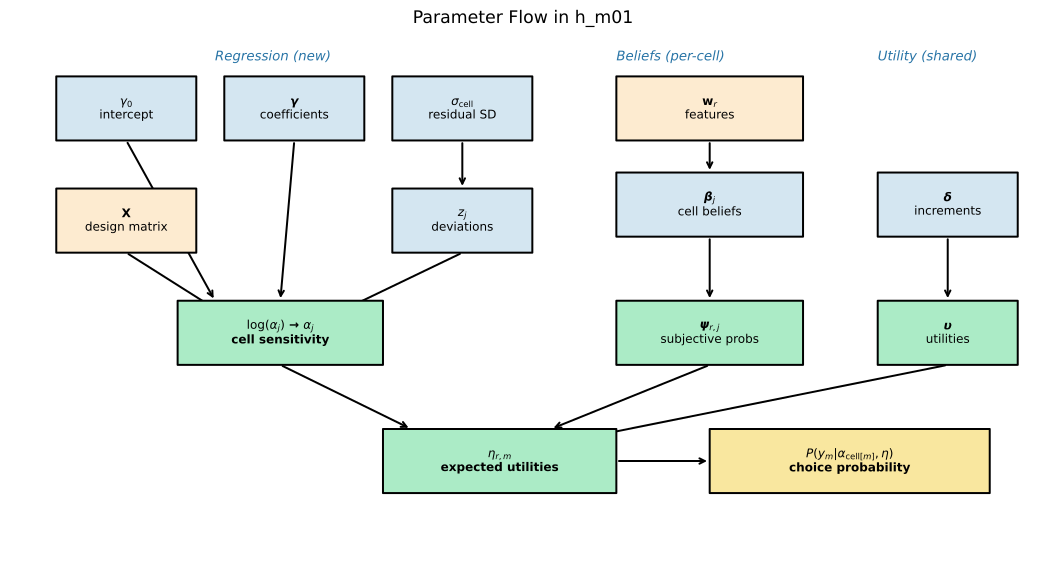
The parameter flow is:
1. **Regression → cell-specific $\alpha_j$**: The regression coefficients $(\gamma_0, \boldsymbol{\gamma})$ combine with the design matrix $\mathbf{X}$ and cell deviations $z_j$ to produce $\log(\alpha_j)$, then exponentiated.
2. **Shared $\boldsymbol{\delta}$ → ordered utilities**: `cumulative_sum(append_row(0, delta))` constructs $\boldsymbol{\upsilon}$ — unchanged from `m_01`.
3. **Cell-specific $\boldsymbol{\beta}_j$ → expected utilities**: For each observation $m$ in cell $j$, the belief parameters $\boldsymbol{\beta}_j$ map features to subjective probabilities $\boldsymbol{\psi}$, which are then dotted with utilities to produce expected utilities $\eta$.
The key difference from `m_01` is the indexing: `beta[j]` (cell $j$'s belief matrix) replaces the single `beta`, and `alpha[cell[m]]` replaces the scalar `alpha`.
```{python}
#| label: fig-parameter-flow
#| fig-cap: "Parameter flow in h_m01. Regression parameters (γ₀, γ, σ_cell) combine with design matrix X and cell deviations z to produce cell-specific α. Cell-specific β maps features to beliefs. Shared δ determines utilities. All three combine to produce choice probabilities."
fig, ax = plt.subplots(figsize=(11, 6))
ax.set_xlim(0, 11)
ax.set_ylim(0, 6.5)
ax.axis('off')

# Box drawing helper
def draw_box(ax, x, y, w, h, text, color='white', edgecolor='black', fontsize=9, bold=False):
    rect = plt.Rectangle((x, y), w, h, facecolor=color, edgecolor=edgecolor, linewidth=1.5, zorder=2)
    ax.add_patch(rect)
    weight = 'bold' if bold else 'normal'
    ax.text(x + w/2, y + h/2, text, ha='center', va='center', fontsize=fontsize, fontweight=weight, zorder=3)

def draw_arrow(ax, x1, y1, x2, y2, color='black'):
    ax.annotate('', xy=(x2, y2), xytext=(x1, y1),
                arrowprops=dict(arrowstyle='->', color=color, lw=1.5), zorder=1)

# --- Regression parameters (top left) ---
draw_box(ax, 0.5, 5.2, 1.5, 0.8, '$\\gamma_0$\nintercept', '#d4e6f1')
draw_box(ax, 2.3, 5.2, 1.5, 0.8, '$\\boldsymbol{\\gamma}$\ncoefficients', '#d4e6f1')
draw_box(ax, 4.1, 5.2, 1.5, 0.8, '$\\sigma_{\\mathrm{cell}}$\nresidual SD', '#d4e6f1')

# Design matrix and z (top right)
draw_box(ax, 0.5, 3.8, 1.5, 0.8, '$\\mathbf{X}$\ndesign matrix', '#fdebd0')
draw_box(ax, 4.1, 3.8, 1.5, 0.8, '$z_j$\ndeviations', '#d4e6f1')

# log(alpha) -> alpha (middle)
draw_box(ax, 1.8, 2.4, 2.2, 0.8, '$\\log(\\alpha_j)$ → $\\alpha_j$\ncell sensitivity', '#abebc6', bold=True)

# Arrows into log(alpha)
draw_arrow(ax, 1.25, 5.2, 2.2, 3.2)
draw_arrow(ax, 3.05, 5.2, 2.9, 3.2)
draw_arrow(ax, 4.85, 5.2, 4.85, 4.6)
draw_arrow(ax, 4.85, 3.8, 3.6, 3.1)
draw_arrow(ax, 1.25, 3.8, 2.2, 3.1)

# --- Belief parameters (right) ---
draw_box(ax, 6.5, 4.0, 2.0, 0.8, '$\\boldsymbol{\\beta}_j$\ncell beliefs', '#d4e6f1')
draw_box(ax, 6.5, 5.2, 2.0, 0.8, '$\\mathbf{w}_r$\nfeatures', '#fdebd0')

# psi (middle right)
draw_box(ax, 6.5, 2.4, 2.0, 0.8, '$\\boldsymbol{\\psi}_{r,j}$\nsubjective probs', '#abebc6')

# Arrows into psi
draw_arrow(ax, 7.5, 5.2, 7.5, 4.8)
draw_arrow(ax, 7.5, 4.0, 7.5, 3.2)

# --- Shared utility (far right) ---
draw_box(ax, 9.3, 4.0, 1.5, 0.8, '$\\boldsymbol{\\delta}$\nincrements', '#d4e6f1')
draw_box(ax, 9.3, 2.4, 1.5, 0.8, '$\\boldsymbol{\\upsilon}$\nutilities', '#abebc6')

# Arrow into upsilon
draw_arrow(ax, 10.05, 4.0, 10.05, 3.2)

# --- Expected utility (bottom center) ---
draw_box(ax, 4.0, 0.8, 2.5, 0.8, '$\\eta_{r,m}$\nexpected utilities', '#abebc6', bold=True)

# Arrows into eta
draw_arrow(ax, 7.5, 2.4, 5.8, 1.6)
draw_arrow(ax, 10.05, 2.4, 6.2, 1.5)

# --- Choice probability (bottom) ---
draw_box(ax, 7.5, 0.8, 3.0, 0.8, '$P(y_m | \\alpha_{\\mathrm{cell}[m]}, \\eta)$\nchoice probability', '#f9e79f', bold=True)

# Arrows into choice prob
draw_arrow(ax, 6.5, 0.8 + 0.4, 7.5, 0.8 + 0.4)
draw_arrow(ax, 2.9, 2.4, 4.3, 1.6)

# Labels
ax.text(2.2, 6.2, 'Regression (new)', fontsize=10, fontstyle='italic', color='#2874a6')
ax.text(6.5, 6.2, 'Beliefs (per-cell)', fontsize=10, fontstyle='italic', color='#2874a6')
ax.text(9.3, 6.2, 'Utility (shared)', fontsize=10, fontstyle='italic', color='#2874a6')

ax.set_title('Parameter Flow in h_m01', fontsize=13, pad=10)
plt.tight_layout()
plt.show()
```
## Prior Distributions
The `model` block specifies priors and the likelihood.
```{.stan filename="h_m01.stan (model block — priors)"}
model {
  // --- Priors ---
  // Regression (tightened 2026-04-23 after parameter recovery showed soft
  // identifiability of alpha with heavy right tail under the original priors)
  gamma0 ~ normal(2.5, 0.5);             // prior on intercept: median alpha ~ 12, 97.5th pct ~ 33
  gamma ~ normal(0, 0.5);                // stronger shrinkage toward no effect
  sigma_cell ~ normal(0, 0.3);           // half-normal: modest cell variation (J=6 weakly identifies)
  z_alpha ~ std_normal();                // non-centered parameterization

  // Beliefs: per-cell, same prior as m_01
  for (j in 1:J) {
    to_vector(beta[j]) ~ std_normal();
  }

  // Utilities: shared
  delta ~ dirichlet(rep_vector(1, K-1));
  // ...
}
```
Each prior is motivated by its role in the model:
| Parameter | Prior | m_01 Analogue | Rationale |
|-----------|-------|---------------|-----------|
| $\gamma_0$ | $\mathcal{N}(2.5, 0.5)$ | $\alpha \sim \text{LogNormal}(3.0, 0.75)$ | Tightened intercept centred so that the prior on $\alpha$ has median $\approx 12$ and 97.5th percentile $\approx 33$, controlling the heavy right tail seen under the original $\mathcal{N}(3.0, 1.0)$ prior |
| $\boldsymbol{\gamma}$ | $\mathcal{N}(0, 0.5)$ | — (new) | Stronger shrinkage toward no effect; a priori, experimental factors don't shift $\alpha$ |
| $\sigma_{\text{cell}}$ | $\text{HalfNormal}(0, 0.3)$ | — (new) | Modest cell-level variation; 0.3 on log scale $\approx$ factor of 1.35. The $J=6$ design weakly identifies $\sigma_{\text{cell}}$, motivating the tighter scale |
| $z_j$ | $\mathcal{N}(0, 1)$ | — (new) | Non-centered parameterization; computational device |
| $\boldsymbol{\beta}_j$ | $\mathcal{N}(0, 1)$ per element | $\boldsymbol{\beta} \sim \mathcal{N}(0, 1)$ per element | Identical to m_01, applied independently per cell |
| $\boldsymbol{\delta}$ | $\text{Dirichlet}(\mathbf{1})$ | $\boldsymbol{\delta} \sim \text{Dirichlet}(\mathbf{1})$ | Unchanged |
: Prior distributions in h_m01 and their m_01 analogues. {#tbl-priors}
::: {.callout-note}
## Connection to m_01 Prior Calibration
The m_01 prior $\alpha \sim \text{LogNormal}(3.0, 0.75)$ was calibrated via prior predictive analysis ([Report 3](03_prior_analysis.qmd)) to yield a prior-implied SEU-max rate of approximately 0.78. The h_m01 priors above are the **tightened** values that match the current `models/h_m01.stan` (commit on 2026-04-24). They were tightened from an earlier $\gamma_0 \sim \mathcal{N}(3.0, 1.0)$, $\boldsymbol{\gamma} \sim \mathcal{N}(0, 1.0)$, $\sigma_{\text{cell}} \sim \text{HalfNormal}(0, 0.5)$ specification after parameter recovery ([Report 11](11_hierarchical_parameter_recovery.qmd)) showed soft identifiability of $\alpha$ with a heavy right tail. The hierarchical prior predictive ([Report 10](10_hierarchical_prior_analysis.qmd)), parameter recovery ([Report 11](11_hierarchical_parameter_recovery.qmd)), and SBC validation ([Report 12](12_hierarchical_sbc_validation.qmd)) all use the tightened priors shown here.
:::
## Likelihood
The likelihood is structurally identical to `m_01`, with one change: `alpha` is indexed by `cell[m]`.
```{.stan filename="h_m01.stan (model block — likelihood)"}
  // --- Likelihood ---
  {
    int pos = 1;
    for (m in 1:M_total) {
      vector[N_obs[m]] problem_eta = segment(eta, pos, N_obs[m]);
      y[m] ~ categorical(softmax(alpha[cell[m]] * problem_eta));
      pos += N_obs[m];
    }
  }
```
Compare to `m_01`:
```{.stan filename="m_01.stan (likelihood)"}
y[m] ~ categorical(softmax(alpha * problem_eta));
```
The only change is `alpha[cell[m]]` replacing the scalar `alpha`. This minimal modification connects the hierarchical regression structure to the observation model: each observation is generated according to its cell's sensitivity parameter.
## Generated Quantities
The `generated quantities` block computes diagnostics for model checking and comparison.
```{.stan filename="h_m01.stan (generated quantities — log-likelihood and predictions)"}
generated quantities {
  // Log-likelihood per observation
  vector[M_total] log_lik;
  {
    int pos = 1;
    for (m in 1:M_total) {
      vector[N_obs[m]] problem_eta = segment(eta, pos, N_obs[m]);
      log_lik[m] = categorical_lpmf(y[m] | softmax(alpha[cell[m]] * problem_eta));
      pos += N_obs[m];
    }
  }

  // Posterior predictive samples
  array[M_total] int y_pred;
  {
    int pos = 1;
    for (m in 1:M_total) {
      vector[N_obs[m]] problem_eta = segment(eta, pos, N_obs[m]);
      y_pred[m] = categorical_rng(softmax(alpha[cell[m]] * problem_eta));
      pos += N_obs[m];
    }
  }
```
Four categories of generated quantities are produced:
1. **Log-likelihood** (`log_lik`): Pointwise, for LOO-CV via the `loo` package. Same structure as `m_01` but with cell-indexed alpha.
2. **Posterior predictive samples** (`y_pred`): For posterior predictive checks. Same structure as `m_01`.
3. **PPC statistics**: Log-likelihood discrepancy, modal choice accuracy, sum of chosen probabilities — all computed globally across all cells, following the same pattern as `m_01`.
4. **Per-cell log-likelihoods** (`log_lik_cell`): **New** — aggregates pointwise log-likelihoods by cell.
```{.stan filename="h_m01.stan (generated quantities — per-cell log-likelihoods)"}
  // Per-cell log-likelihoods (for cell-level model comparison)
  vector[J] log_lik_cell = rep_vector(0, J);
  for (m in 1:M_total) {
    log_lik_cell[cell[m]] += log_lik[m];
  }
}
```
The `log_lik_cell` vector enables diagnosing cells where the model fits poorly — a form of cell-level residual analysis that is unique to the hierarchical setting.
## The Simulation Model (`h_m01_sim.stan`) {#sec-sim-model}
The simulation model generates synthetic choice data from the `h_m01` prior, for use in prior predictive analysis and parameter recovery studies. All parameter generation occurs in `generated quantities` with `fixed_param=True` (no sampling needed).
```{.stan filename="h_m01_sim.stan (generated quantities — parameter generation)"}
generated quantities {
  // Draw regression parameters
  real gamma0 = normal_rng(gamma0_mean, gamma0_sd);
  vector[P] gamma;
  for (p in 1:P) {
    gamma[p] = normal_rng(0, gamma_sd);
  }
  real<lower=0> sigma_cell = abs(normal_rng(0, sigma_cell_sd));

  // Draw cell-level alphas
  vector[J] log_alpha;
  vector[J] alpha;
  for (j in 1:J) {
    real z_j = normal_rng(0, 1);
    log_alpha[j] = gamma0 + X[j] * gamma + sigma_cell * z_j;
    alpha[j] = exp(log_alpha[j]);
  }

  // Draw per-cell betas
  array[J] matrix[K, D] beta;
  for (j in 1:J) {
    for (k in 1:K) {
      for (d in 1:D) {
        beta[j][k, d] = normal_rng(0, beta_sd);
      }
    }
  }

  // Draw shared utilities
  simplex[K-1] delta = dirichlet_rng(rep_vector(1.0, K-1));
  vector[K] upsilon = cumulative_sum(append_row(0, delta));

  // Compute expected utilities and generate choices
  array[M_total] int y;
  {
    int pos = 1;
    for (m in 1:M_total) {
      int j = cell[m];
      vector[N_obs[m]] problem_eta;
      for (idx in 1:N_obs[m]) {
        vector[K] psi_i = softmax(beta[j] * x_flat[pos]);
        problem_eta[idx] = dot_product(psi_i, upsilon);
        pos += 1;
      }
      y[m] = categorical_rng(softmax(alpha[j] * problem_eta));
    }
  }
}
```
Key design features:
- **Hyperparameter controls** (`gamma0_mean`, `gamma0_sd`, `gamma_sd`, `sigma_cell_sd`, `beta_sd`) are passed as data, allowing the prior to be varied without recompiling the model.
- The structure mirrors [Report 2](02_concrete_implementation.qmd)'s `m_01_sim.stan`, extended for the hierarchical regression and per-cell beliefs.
## The SBC Model (`h_m01_sbc.stan`) {#sec-sbc-model}
The SBC (simulation-based calibration) model [@talts2018] combines parameter generation, data generation, and model fitting in a single Stan program. True parameters are drawn in `transformed data` (so they are fixed per chain), synthetic data are generated from those parameters, and the model is fit in the `model` block. The `generated quantities` block produces rank statistics for calibration checking.
```{.stan filename="h_m01_sbc.stan (generated quantities — rank statistics)"}
generated quantities {
  // Copy generated data
  array[M_total] int y_ = y;

  vector[2 + P + J + (K - 1)] pars_;
  vector[2 + P + J + (K - 1)] ranks_;
  {
    int idx = 1;

    // gamma0
    pars_[idx] = gamma0_;
    ranks_[idx] = (gamma0 > gamma0_) ? 1 : 0;
    idx += 1;

    // gamma
    for (p in 1:P) {
      pars_[idx] = gamma_[p];
      ranks_[idx] = (gamma[p] > gamma_[p]) ? 1 : 0;
      idx += 1;
    }

    // sigma_cell
    pars_[idx] = sigma_cell_;
    ranks_[idx] = (sigma_cell > sigma_cell_) ? 1 : 0;
    idx += 1;

    // alpha (per cell)
    for (j in 1:J) {
      pars_[idx] = alpha_[j];
      ranks_[idx] = (alpha[j] > alpha_[j]) ? 1 : 0;
      idx += 1;
    }

    // delta
    for (k in 1:(K-1)) {
      pars_[idx] = delta_[k];
      ranks_[idx] = (delta[k] > delta_[k]) ? 1 : 0;
      idx += 1;
    }
  }
```
The parameter ordering in `pars_`/`ranks_` is: $\gamma_0$, $\gamma_1, \ldots, \gamma_P$, $\sigma_{\text{cell}}$, $\alpha_1, \ldots, \alpha_J$, $\delta_1, \ldots, \delta_{K-1}$.
::: {.callout-note}
## Design Decision: Which Parameters to Track
Per-cell $\boldsymbol{\beta}_j$ matrices are **not** tracked in SBC — with $J \times K \times D$ elements, rank histograms would be unreadable. $\boldsymbol{\beta}$ calibration can be spot-checked separately. The tracked parameters are those with direct scientific interpretation: the regression structure ($\gamma_0, \boldsymbol{\gamma}, \sigma_{\text{cell}}$), cell-level sensitivities ($\alpha_j$), and utilities ($\boldsymbol{\delta}$).
:::
Note that the `pars_`/`ranks_` vector size is computed inline as `2 + P + J + (K - 1)` rather than stored in a local variable. This is a necessary workaround: Stan does not permit non-data variables in top-level size declarations.
## The Study Design Utility {#sec-study-design}
The `HierarchicalStudyDesign` class in `utils/study_design_hierarchical.py` generates stacked data structures for `h_m01`. The typical workflow is:
```python
from utils.study_design_hierarchical import HierarchicalStudyDesign

design = HierarchicalStudyDesign(
    J=6, K=3, D=2, R=10, P=2,
    M_per_cell=20,
    X=np.array([[0,0], [0,1], [1,0], [1,1], [1,0], [0,1]])
)
design.generate()           # Generate feature vectors and indicator arrays
data = design.get_data_dict()  # Stan-compatible data dictionary
design.save("design.json")  # Persist for reproducibility
```
Key features:
- **Constructor** accepts all design parameters: `J`, `K`, `D`, `R`, `P`, `M_per_cell` (scalar or per-cell list), design matrix `X`, and feature generation settings.
- **`generate()`** creates shared feature vectors $\mathbf{w}_r$ and the stacked indicator array with cell membership vector.
- **`get_data_dict()`** returns a dictionary matching the `h_m01.stan` data block, including default simulation hyperparameters (`gamma0_mean=2.5`, `gamma0_sd=0.5`, `gamma_sd=0.5`, `sigma_cell_sd=0.3`, `beta_sd=1.0`). These tightened values were calibrated via the prior-predictive, parameter-recovery, and SBC analyses in [Reports 10–12](10_hierarchical_prior_analysis.qmd).
- **`save()` / `load()`** serialize the design to JSON with metadata (design name, timestamp, feature distribution parameters) for reproducibility.
## Summary
The following table summarizes how each `m_01` component maps to `h_m01`:
| m_01 Component | h_m01 Component | Change |
|----------------|-----------------|--------|
| `alpha` (scalar) | `alpha[J]` (vector) | Scalar → $J$-dimensional, via regression structure |
| `beta` (matrix) | `beta[J]` (array of matrices) | Single → per-cell |
| `delta` (simplex) | `delta` (simplex) | Unchanged |
| $M$ observations | $M_{\text{total}}$ stacked observations + `cell[m]` | Single group → stacked multi-cell |
| $\text{LogNormal}(3.0, 0.75)$ prior on $\alpha$ | $\mathcal{N}(3.0, 1.0)$ on $\gamma_0$ + regression + half-normal on $\sigma_{\text{cell}}$ | Prior on $\alpha$ mediated by regression |
: Mapping from m_01 to h_m01 components. {#tbl-component-mapping}
The implementation changes are minimal — the likelihood differs only in indexing `alpha[cell[m]]` rather than a scalar `alpha` — but the inferential consequences are substantial: formal regression coefficients, partial pooling, and principled shrinkage across experimental cells.
::: {.callout-note}
## Connection to Earlier Reports
- [Report 1](01_abstract_formulation.qmd): Softmax choice properties hold within each cell
- [Report 2](02_concrete_implementation.qmd): Base `m_01` implementation that `h_m01` extends
- [Reports 5–7](05_adding_risky_choices.qmd): Risky-choice extensions could also be hierarchicalized
- [Report 8](08_hierarchical_formulation.qmd): Abstract formulation implemented here
:::