---
title: "Temperature and SEU Sensitivity: Risky Alternatives Extension"
subtitle: "Application Report: Temperature Study 2"
description: |
Extends the initial temperature study by introducing risky alternatives
alongside the original uncertain alternatives, enabling joint estimation
under models m_11, m_21, and m_31.
categories: [applications, temperature, m_11, m_21, m_31, risky]
execute:
cache: true
---
```{python}
#| label: setup
#| include: false
import sys
import os
reports_root = os.path.normpath(os.path.join(os.getcwd(), '..', '..'))
project_root = os.path.dirname(reports_root)
sys.path.insert(0, reports_root)
sys.path.insert(0, project_root)
import numpy as np
import json
import yaml
import warnings
warnings.filterwarnings('ignore')
import matplotlib.pyplot as plt
import pandas as pd
# Use project plotting style
from report_utils import set_seu_style, SEU_COLORS, SEU_PALETTE
set_seu_style()
# Data directory (frozen snapshot)
from pathlib import Path
data_dir = Path("data")
# Temperatures and labels used throughout
temperatures = [0.0, 0.3, 0.7, 1.0, 1.5]
temp_labels = {t: f"T={t}" for t in temperatures}
temp_keys = ["T0_0", "T0_3", "T0_7", "T1_0", "T1_5"]
temp_key_map = dict(zip(temperatures, temp_keys))
```
## Introduction
[Report 1](../temperature_study/01_initial_study.qmd) established that the estimated sensitivity parameter $\alpha$ of GPT-4o decreases with sampling temperature, using the **m_01** model — a single-context softmax choice model fit to uncertain alternatives whose probabilities are inferred from embedded text features. That study demonstrated a clear negative relationship between temperature and EU sensitivity, with a posterior probability exceeding 0.99 that the global slope is negative.
This report extends that analysis in two ways:
1. **Adding risky alternatives.** We collect a new set of choice data in which the LLM chooses among alternatives whose outcome probabilities are *stated explicitly* (risky alternatives), rather than inferred from features (uncertain alternatives). This creates a paired dataset: each temperature condition now has $M = 300$ uncertain decisions and $N = 300$ risky decisions ($N = 299$ at $T = 1.5$ due to one unparseable response).
2. **A family of augmented models.** We fit three models that jointly estimate sensitivity from both decision contexts:
- **m_11** — shared sensitivity $\alpha$ across uncertain and risky choices
- **m_21** — separate sensitivities $\alpha$ (uncertain) and $\omega$ (risky)
- **m_31** — proportional sensitivities with $\omega = \kappa \cdot \alpha$
The central questions are: *(i)* Does the temperature–sensitivity relationship replicate when risky alternatives are included? *(ii)* Does sensitivity differ between uncertain and risky contexts? *(iii)* If so, is the difference proportional across temperatures?
::: {.callout-note}
## What This Report Covers
This report presents data collection, prior calibration, model fitting, posterior predictive checks, and monotonicity analysis for the augmented models. It builds directly on the uncertain-choice data and m_01 results from [Report 1](../temperature_study/01_initial_study.qmd).
:::
::: {.callout-important}
## Construct Validity: Why Adding Risky Alternatives Matters
[Report 1](../temperature_study/01_initial_study.qmd) flagged a
fundamental interpretive limit of the m_0 / m_01 family: because the
design uses only *uncertain* (assessment-elicited) choices, the
feature-to-probability weights $\beta$ and the utility increments
$\delta$ are not separately identified. Operationally, $\alpha$ in
m_01 measures the consistency with which choices align with the
*model-implied* utility ranking — not necessarily with the agent's
"true" subjective expected utility. In the three-layer construct-
validity scheme of the initial-study report, m_01 supports
**comparative** claims across conditions sharing a stimulus pool
(layer 2), but **not absolute, agent-level rationality** claims
(layer 3).
Risky alternatives are the principled relaxation of that limitation.
By presenting probabilities *explicitly* — as a $K$-simplex over
consequences — risky choices give $\delta$ direct identifying
information that uncertain choices alone cannot provide:
$\eta^{(r)} = x^\top \upsilon$ depends on $\delta$ through
$\upsilon = \mathrm{cumsum}([0,\delta])$ but no longer through $\beta$,
so risky-choice likelihood contributions identify $\delta$ separately
from the uncertain-choice $\beta$. This is exactly the missing
identifying information called for in §Construct Validity of
[Report 1](../temperature_study/01_initial_study.qmd) and motivates
the m_1 / m_2 / m_3 ladder that this report instantiates as
m_11 / m_21 / m_31.
The three augmented models map onto the construct-validity layers
as follows:
* **m_11 (shared $\alpha$).** Stays at layer (2) but with **tighter
posteriors**: the risky data adds a second source of evidence
about the same sensitivity parameter, sharpening within-condition
precision without introducing new claim types.
* **m_21 (separate $\alpha$ and $\omega$).** Opens a new layer-(2)
contrast — *between contexts* (uncertain vs risky) — that the
m_0 / m_01 family cannot estimate at all.
* **m_31 ($\omega = \kappa\alpha$).** The proportionality parameter
$\kappa$ is the cleanest summary the project produces of *between-
context* sensitivity differences. As a **ratio**, $\kappa$ is
robust to the absolute scaling of the model-implied utility:
whatever residual identifiability concern attaches to the absolute
level of $\alpha$ or $\omega$ cancels in the ratio. This is the
closest the m_1 / m_2 / m_3 family comes to a layer-(3)–adjacent
quantity.
This setup motivates the three central questions of this report
listed above. It also explains the methodological status of this
report in the broader applications programme: it is the empirical
proof-of-concept for the m_1 / m_2 / m_3 follow-up sequencing flagged
in §0.5 of
[`prompts/hierarchical_alignment_study_plan.md`](../../../prompts/hierarchical_alignment_study_plan.md)
— that is, what an alignment-style follow-up would look like once
the construct-validity caveats of m_01 / h_m01 motivate the move to
designs with risky alternatives.
:::
## Experimental Design {#sec-design}
### Risky Alternatives
The uncertain alternatives from the initial study use the same insurance claims triage task: embedded natural-language assessments produce features $w_r \in \mathbb{R}^D$, and the model infers subjective probabilities $\psi_r = \text{softmax}(\beta \cdot w_r)$ over $K = 3$ consequences. The *risky* alternatives replace this inference step with explicitly stated probability simplexes:
```{python}
#| label: risky-pool
#| echo: false
with open(data_dir / "risky_alternatives.json") as f:
risky_pool = json.load(f)
alts = risky_pool["risky_alternatives"]
S = len(alts)
print(f"Risky alternatives pool: S = {S}")
print(f"Each alternative specifies a simplex over K = 3 consequences.")
print()
# Show a sample
sample_alts = alts[:6]
rows = []
for a in sample_alts:
rows.append({
"ID": a["id"],
"p(neither)": a["probabilities"][0],
"p(one)": a["probabilities"][1],
"p(both)": a["probabilities"][2],
})
pd.DataFrame(rows)
```
The $S = 30$ risky alternatives span a range of probability profiles: corner alternatives concentrating mass on a single consequence (e.g., $[0.90, 0.05, 0.05]$), balanced alternatives (e.g., $[1/3, 1/3, 1/3]$), and intermediate cases. Each risky decision problem draws 2–4 alternatives uniformly at random (without replacement) from the pool of 30, with a fresh draw for each of the 100 base problems. The same position-counterbalancing design is used as in the uncertain case: 100 base problems $\times$ 3 presentations with shuffled orderings. All draws use the study-level random seed recorded in the frozen data snapshot, ensuring exact reproducibility.
::: {.callout-note}
## Terminology: "Uncertain" vs. "Ambiguous"
Throughout this report, we use "uncertain" to describe the decision context in which probabilities must be inferred from natural-language features, and "risky" for the context in which probabilities are stated explicitly. In the JDM literature, the former is closer to what is typically called "ambiguity" (unknown or imprecise probabilities) and the latter to "risk" (known probabilities). We retain "uncertain" for consistency with [Report 1](../temperature_study/01_initial_study.qmd) and the model notation, but the connection to the classic risk–ambiguity distinction (Ellsberg, 1961) is substantive and is discussed in @sec-discussion.
:::
### Design Parameters
```{python}
#| label: design-params
#| echo: true
with open(data_dir / "study_config.yaml") as f:
    config = yaml.safe_load(f)

with open(data_dir / "run_summary.json") as f:
    run_summary = json.load(f)

t0_info = run_summary['phases']['phase3_data_prep']['per_temperature']['0.0']
print(f"Study Design:")
print(f"  Uncertain problems (M):  {t0_info['M']}  (100 base × 3 presentations)")
print(f"  Risky problems (N):      {t0_info['N']}  (100 base × 3 presentations)")
print(f"  Uncertain alternatives:  R = {t0_info['R']}")
print(f"  Risky alternatives:      S = {t0_info['S']}")
print(f"  Alternatives per problem: {config['min_alternatives']}–{config['max_alternatives']}")
print(f"  Consequences (K):        {config['K']}")
print(f"  Embedding dimensions (D): {t0_info['D']}")
print(f"  LLM model:               {config['llm_model']}")
print(f"  Temperature conditions:   {config['temperatures']}")
```
```{python}
#| label: tbl-design-comparison
#| tbl-cap: "Comparison of uncertain and risky decision contexts."
#| echo: false
design_df = pd.DataFrame({
"": ["Uncertain (m_01 data)", "Risky (new data)"],
"Observations": ["M = 300 per temp", "N = 300 per temp (299 at T=1.5)"],
"Alternatives": ["R = 30 distinct", "S = 30 distinct"],
"Per problem": ["2–4 alternatives", "2–4 alternatives"],
"Probabilities": ["Inferred via β·w → softmax", "Stated explicitly (simplexes)"],
"Sensitivity": ["α (all models)", "α (m_11) / ω (m_21, m_31)"],
})
design_df
```
### Data Quality
```{python}
#| label: data-quality
#| echo: false
na = run_summary['phases']['phase2_risky_choices']['na_summary']
print(f"Risky Choice NA Summary:")
print(f" Overall: {na['overall']['na']} / {na['overall']['total']} ({na['overall']['na_rate']:.2%})")
for key, val in na['per_temperature'].items():
print(f" {key}: {val['na']} / {val['total']} ({val['na_rate']:.2%})")
```
Data quality is excellent: only 1 unparseable response out of 1,500 risky choices (at $T = 1.5$), matching the near-perfect parsing observed in the initial uncertain study.
::: {.callout-note}
## Sample Size
The sample sizes ($M = 300$ uncertain, $N = 300$ risky per temperature) were chosen to match the initial study's design while remaining computationally tractable for the augmented models. No formal power analysis was conducted to determine the sample size needed for precise estimation of $\kappa$ or for discriminating between m_11 and m_31. As will become apparent (@sec-results), the credible intervals on $\kappa$ are wide enough that a larger study would improve precision. The sample size adequacy for the primary finding—replication of the temperature–$\alpha$ relationship—is supported by the strong posterior separation observed.
:::
## Model Family {#sec-models}
All three augmented models share: (1) the same utility function $\upsilon = \text{cumulative\_sum}([0, \delta])$ with $\delta \sim \text{Dirichlet}(\mathbf{1})$, (2) subjective probabilities $\psi_r = \text{softmax}(\beta \cdot w_r)$ for uncertain alternatives with $\beta \sim \mathcal{N}(0, 1)$, and (3) the calibrated prior $\alpha \sim \text{Lognormal}(3.0, 0.75)$ from [Report 1](../temperature_study/01_initial_study.qmd). They differ only in how sensitivity governs risky choices.
### Model Specifications
```{python}
#| label: tbl-model-specs
#| tbl-cap: "Parameter specifications for the three augmented models. All models share the same utility and subjective probability structure."
#| echo: false
specs = pd.DataFrame({
"Model": ["m_11", "m_21", "m_31"],
"Uncertain sensitivity": [
"α ~ LN(3.0, 0.75)",
"α ~ LN(3.0, 0.75)",
"α ~ LN(3.0, 0.75)",
],
"Risky sensitivity": [
"α (shared with uncertain)",
"ω ~ LN(3.0, 0.75)",
"ω = κ·α, κ ~ LN(0, 0.5)",
],
"Free parameters": ["α, β, δ", "α, ω, β, δ", "α, κ, β, δ"],
"Interpretation": [
"Single sensitivity governs both contexts",
"Contexts have independent sensitivities",
"Sensitivities are proportionally linked",
],
})
specs
```
The key structural differences:
- **m_11** forces the same $\alpha$ to explain both uncertain and risky choices. The risky data provides additional constraint, yielding tighter posteriors.
- **m_21** gives each context its own sensitivity parameter. If $\omega \neq \alpha$, the LLM processes explicit probabilities differently from inferred ones.
- **m_31** nests between the other two: when $\kappa = 1$, it reduces to m_11; when $\kappa$ deviates from 1, it captures a multiplicative scaling of sensitivity in the risky context. The prior $\kappa \sim \text{Lognormal}(0, 0.5)$ centers at 1 with 90% CI $\approx [0.44, 2.28]$.
### Relationship to m_01
The m_01 model from [Report 1](../temperature_study/01_initial_study.qmd) fits only uncertain choices: $y_m \sim \text{Categorical}(\text{softmax}(\alpha \cdot \eta^{(u)}_m))$. The augmented models extend this by adding a second likelihood for risky choices: $z_n \sim \text{Categorical}(\text{softmax}(\alpha_{\text{risky}} \cdot \eta^{(r)}_n))$, where $\eta^{(r)}_n = x_s' \upsilon$ uses the *stated* probability simplexes $x_s$ rather than inferred subjective probabilities. The utility function $\upsilon$ and $\beta$ parameters are estimated jointly from both data sources.
## Prior Predictive Calibration {#sec-prior-calibration}
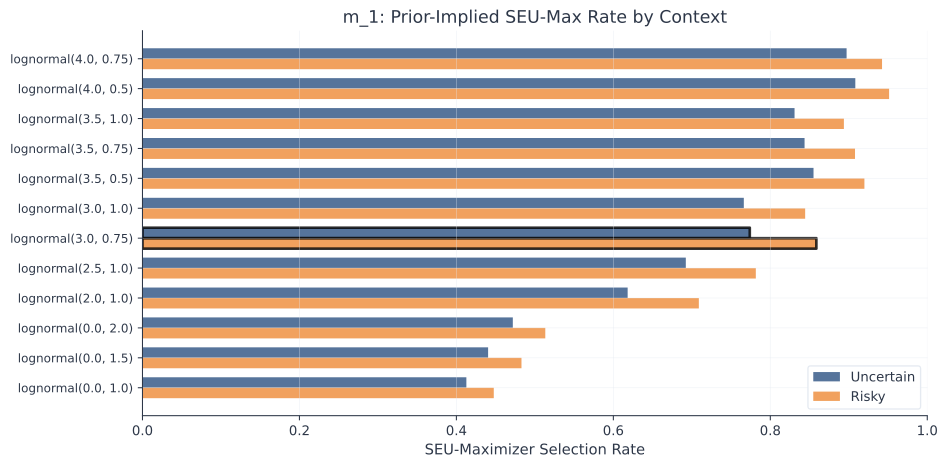
Prior predictive simulation was performed using the `_sim.stan` variants of each model on the actual augmented study design. For each candidate prior, we drew parameter values and simulated choices, computing the SEU-maximizer selection rate separately for uncertain and risky contexts.
```{python}
#| label: fig-prior-grid-m1
#| fig-cap: "Prior predictive SEU-maximizer selection rates for m_1 across candidate α priors. Risky alternatives yield consistently higher SEU-max rates than uncertain alternatives at the same prior, reflecting the easier decision structure when probabilities are known. The selected prior lognormal(3.0, 0.75) produces combined rates near 0.82."
#| fig-height: 5
with open(data_dir / "prior_predictive" / "m_1_grid_results.json") as f:
    m1_grid = json.load(f)

results = m1_grid['results']

fig, ax = plt.subplots(figsize=(10, 5))

labels = [r['prior_label'] for r in results]
y_pos = np.arange(len(labels))

unc_means = [r['seu_rate_uncertain_mean'] for r in results]
risky_means = [r['seu_rate_risky_mean'] for r in results]

bar_height = 0.35
bars_unc = ax.barh(y_pos + bar_height/2, unc_means, bar_height,
                    color=SEU_COLORS['primary'], alpha=0.8, label='Uncertain')
bars_risky = ax.barh(y_pos - bar_height/2, risky_means, bar_height,
                      color=SEU_COLORS['accent'], alpha=0.8, label='Risky')

# Highlight selected prior
selected_idx = [i for i, l in enumerate(labels) if 'lognormal(3.0, 0.75)' in l][0]
bars_unc[selected_idx].set_edgecolor('black')
bars_unc[selected_idx].set_linewidth(2)
bars_risky[selected_idx].set_edgecolor('black')
bars_risky[selected_idx].set_linewidth(2)

ax.set_yticks(y_pos)
ax.set_yticklabels(labels, fontsize=9)
ax.set_xlabel('SEU-Maximizer Selection Rate')
ax.set_title('m_1: Prior-Implied SEU-Max Rate by Context')
ax.legend(fontsize=10)
ax.set_xlim(0, 1)

plt.tight_layout()
plt.show()
```
The prior predictive analysis reveals a consistent pattern across all three models: risky alternatives produce higher SEU-max rates than uncertain alternatives at the same sensitivity level. This is expected—when probabilities are stated explicitly, there is no estimation error in $\psi$; the only source of suboptimality is the softmax noise governed by the sensitivity parameter,
For m_21 and m_31, the joint prior space was searched over 2D grids. The selected priors — $\alpha \sim \text{LN}(3.0, 0.75)$ and $\omega \sim \text{LN}(3.0, 0.75)$ for m_21, $\kappa \sim \text{LN}(0.0, 0.5)$ for m_31 — yield prior-implied SEU-max rates of approximately 0.77 (uncertain) and 0.85 (risky), a sensible range for GPT-4o behavior.
## Results {#sec-results}
### Loading Posterior Draws
```{python}
#| label: load-posteriors
#| output: false
# Load all draws
alpha_draws = {model: {} for model in ['m_11', 'm_21', 'm_31']}
omega_draws = {model: {} for model in ['m_21', 'm_31']}
kappa_draws = {}

for model in ['m_11', 'm_21', 'm_31']:
    for t, tk in zip(temperatures, temp_keys):
        d = np.load(data_dir / f"alpha_draws_{model}_{tk}.npz")
        alpha_draws[model][t] = d['alpha']

for t, tk in zip(temperatures, temp_keys):
    d = np.load(data_dir / f"omega_draws_m_21_{tk}.npz")
    omega_draws['m_21'][t] = d['omega']
    d = np.load(data_dir / f"omega_draws_m_31_{tk}.npz")
    omega_draws['m_31'][t] = d['omega']
    d = np.load(data_dir / f"kappa_draws_m_31_{tk}.npz")
    kappa_draws[t] = d['kappa']

with open(data_dir / "parameter_summary.json") as f:
    param_summary = json.load(f)
with open(data_dir / "ppc_summary.json") as f:
    ppc_summary = json.load(f)
with open(data_dir / "fit_summary.json") as f:
    fit_summary = json.load(f)

# Load m_01 comparison data
with open(data_dir / "m01_fit_summary.json") as f:
    m01_summary = json.load(f)
with open(data_dir / "m01_primary_analysis.json") as f:
    m01_analysis = json.load(f)
```
```{python}
#| echo: false
for model in ['m_11', 'm_21', 'm_31']:
n = len(alpha_draws[model][temperatures[0]])
print(f" {model}: {n:,} posterior draws per temperature")
```
### MCMC Diagnostics
All 15 fits (3 models × 5 temperatures) achieved clean MCMC diagnostics: no divergences, no treedepth warnings, satisfactory E-BFMI, and $\hat{R} < 1.005$ for all parameters.
```{python}
#| label: tbl-diagnostics
#| tbl-cap: "MCMC diagnostics for key parameters across all models and temperatures. All fits used 4 chains × 1,000 warmup + 1,000 sampling iterations."
#| echo: false
diag_rows = []
for model in ['m_11', 'm_21', 'm_31']:
for t in temperatures:
tk = temp_key_map[t]
p = param_summary[model][tk]
row = {
'Model': model,
'T': t,
'α R̂': f"{p['alpha_rhat']:.4f}",
'α ESS': f"{p['alpha_ess_bulk']:.0f}",
}
if model == 'm_21':
row['ω R̂'] = f"{p.get('omega_rhat', float('nan')):.4f}"
row['ω ESS'] = f"{p.get('omega_ess_bulk', float('nan')):.0f}"
elif model == 'm_31':
row['κ R̂'] = f"{p.get('kappa_rhat', float('nan')):.4f}"
row['κ ESS'] = f"{p.get('kappa_ess_bulk', float('nan')):.0f}"
diag_rows.append(row)
pd.DataFrame(diag_rows).fillna('')
```
### Posterior Summaries: m_11 (Shared α)
```{python}
#| label: tbl-m11-posteriors
#| tbl-cap: "m_11: Posterior summaries for the shared sensitivity parameter α. Intervals are 90% credible intervals."
#| echo: false
rows = []
for t in temperatures:
tk = temp_key_map[t]
p = param_summary['m_11'][tk]
rows.append({
'Temp': t,
'Median': f"{p['alpha_median']:.1f}",
'Mean': f"{p['alpha_mean']:.1f}",
'SD': f"{p['alpha_sd']:.1f}",
'90% CI': f"[{p['alpha_q05']:.1f}, {p['alpha_q95']:.1f}]",
})
pd.DataFrame(rows)
```
### Posterior Summaries: m_21 (Separate α, ω)
```{python}
#| label: tbl-m21-posteriors
#| tbl-cap: "m_21: Posterior summaries for α (uncertain) and ω (risky). The separate parametrization reveals systematically lower sensitivity in the risky context."
#| echo: false
rows = []
for t in temperatures:
tk = temp_key_map[t]
p = param_summary['m_21'][tk]
rows.append({
'Temp': t,
'α median': f"{p['alpha_median']:.1f}",
'α 90% CI': f"[{p['alpha_q05']:.1f}, {p['alpha_q95']:.1f}]",
'ω median': f"{p['omega_median']:.1f}",
'ω 90% CI': f"[{p['omega_q05']:.1f}, {p['omega_q95']:.1f}]",
})
pd.DataFrame(rows)
```
### Posterior Summaries: m_31 (ω = κ·α)
```{python}
#| label: tbl-m31-posteriors
#| tbl-cap: "m_31: Posterior summaries for α, κ, and the derived ω = κ·α. The proportionality parameter κ clusters below 1.0, confirming reduced risky sensitivity."
#| echo: false
rows = []
for t in temperatures:
tk = temp_key_map[t]
p = param_summary['m_31'][tk]
rows.append({
'Temp': t,
'α median': f"{p['alpha_median']:.1f}",
'α 90% CI': f"[{p['alpha_q05']:.1f}, {p['alpha_q95']:.1f}]",
'κ median': f"{p['kappa_median']:.3f}",
'κ 90% CI': f"[{p['kappa_q05']:.3f}, {p['kappa_q95']:.3f}]",
'ω median': f"{p['omega_median']:.1f}",
'ω 90% CI': f"[{p['omega_q05']:.1f}, {p['omega_q95']:.1f}]",
})
pd.DataFrame(rows)
```
### Forest Plot: α Across Models
```{python}
#| label: fig-forest-alpha
#| fig-cap: "Forest plot of posterior α distributions across models and temperatures. m_11 (shared α) produces the tightest posteriors. m_21 and m_31 (which allow risky sensitivity to vary) estimate higher α for the uncertain context, reflecting the additional degrees of freedom."
#| fig-height: 7
from scipy.stats import gaussian_kde

fig, axes = plt.subplots(1, 3, figsize=(14, 6), sharey=True)

model_names = ['m_11', 'm_21', 'm_31']
model_titles = ['m₁₁ (shared α)', 'm₂₁ (α for uncertain)', 'm₃₁ (α for uncertain)']

for ax, model, title in zip(axes, model_names, model_titles):
    y_positions = np.arange(len(temperatures))[::-1]

    for i, t in enumerate(temperatures):
        draws = alpha_draws[model][t]
        median = np.median(draws)
        q05, q25, q75, q95 = np.percentile(draws, [5, 25, 75, 95])

        y = y_positions[i]
        color = SEU_PALETTE[i]

        # Thin bar: 90% CI
        ax.plot([q05, q95], [y, y], color=color, linewidth=1.5, solid_capstyle='round')
        # Thick bar: 50% CI
        ax.plot([q25, q75], [y, y], color=color, linewidth=4, solid_capstyle='round')
        # Point: median
        ax.plot(median, y, 'o', color=color, markersize=8, zorder=5)

    ax.set_yticks(y_positions)
    ax.set_yticklabels([f'T = {t}' for t in temperatures])
    ax.set_xlabel('α')
    ax.set_title(title)
    ax.grid(axis='x', alpha=0.3)

plt.suptitle('Posterior α by Temperature and Model', fontsize=14, y=1.02)
plt.tight_layout()
plt.show()
```
### Risky Sensitivity: ω and κ
```{python}
#| label: fig-omega-kappa
#| fig-cap: "Left: Posterior ω (risky sensitivity) from m_21 and m_31 across temperatures. The two models produce consistent ω estimates, both showing the temperature–sensitivity decline. Right: Posterior κ from m_31. The proportionality parameter clusters below 1.0, indicating that the LLM is systematically less sensitive to EU in the risky context. The 90% CIs include 1.0 at some temperatures."
#| fig-height: 5
fig, (ax1, ax2) = plt.subplots(1, 2, figsize=(12, 5))

# Left: ω comparison
y_positions = np.arange(len(temperatures))[::-1]

for i, t in enumerate(temperatures):
    # m_21 omega
    draws_21 = omega_draws['m_21'][t]
    med_21 = np.median(draws_21)
    q05_21, q25_21, q75_21, q95_21 = np.percentile(draws_21, [5, 25, 75, 95])

    y = y_positions[i] + 0.15
    ax1.plot([q05_21, q95_21], [y, y], color=SEU_COLORS['primary'], linewidth=1.5)
    ax1.plot([q25_21, q75_21], [y, y], color=SEU_COLORS['primary'], linewidth=4)
    ax1.plot(med_21, y, 'o', color=SEU_COLORS['primary'], markersize=7)

    # m_31 omega (derived)
    draws_31 = omega_draws['m_31'][t]
    med_31 = np.median(draws_31)
    q05_31, q25_31, q75_31, q95_31 = np.percentile(draws_31, [5, 25, 75, 95])

    y = y_positions[i] - 0.15
    ax1.plot([q05_31, q95_31], [y, y], color=SEU_COLORS['accent'], linewidth=1.5)
    ax1.plot([q25_31, q75_31], [y, y], color=SEU_COLORS['accent'], linewidth=4)
    ax1.plot(med_31, y, 's', color=SEU_COLORS['accent'], markersize=7)

ax1.set_yticks(y_positions)
ax1.set_yticklabels([f'T = {t}' for t in temperatures])
ax1.set_xlabel('ω (risky sensitivity)')
ax1.set_title('Posterior ω by Temperature')
ax1.legend(['m₂₁ (free ω)', '', '', 'm₃₁ (ω = κ·α)', '', ''],
           loc='upper right', fontsize=9)
ax1.grid(axis='x', alpha=0.3)

# Right: κ from m_31
for i, t in enumerate(temperatures):
    draws = kappa_draws[t]
    median = np.median(draws)
    q05, q25, q75, q95 = np.percentile(draws, [5, 25, 75, 95])

    y = y_positions[i]
    color = SEU_PALETTE[i]

    ax2.plot([q05, q95], [y, y], color=color, linewidth=1.5)
    ax2.plot([q25, q75], [y, y], color=color, linewidth=4)
    ax2.plot(median, y, 'o', color=color, markersize=8, zorder=5)

ax2.axvline(x=1.0, color='gray', linestyle='--', alpha=0.5, label='κ = 1 (m₁₁ equiv.)')
ax2.set_yticks(y_positions)
ax2.set_yticklabels([f'T = {t}' for t in temperatures])
ax2.set_xlabel('κ')
ax2.set_title('m₃₁: Posterior κ (ω/α ratio)')
ax2.legend(fontsize=9)
ax2.grid(axis='x', alpha=0.3)

plt.tight_layout()
plt.show()
```
### Posterior Densities
```{python}
#| label: fig-density-alpha
#| fig-cap: "Posterior density of α for each temperature under m_11 (shared α). The clear separation between low-temperature (T ≤ 0.7) and high-temperature (T ≥ 1.0) conditions replicates the pattern from the m_01 analysis, but with substantially tighter posteriors owing to the doubled data."
#| fig-height: 5
fig, ax = plt.subplots(figsize=(8, 5))

for i, t in enumerate(temperatures):
    draws = alpha_draws['m_11'][t]
    kde = gaussian_kde(draws)
    x_grid = np.linspace(draws.min() * 0.8, draws.max() * 1.2, 300)
    ax.fill_between(x_grid, kde(x_grid), alpha=0.15, color=SEU_PALETTE[i])
    ax.plot(x_grid, kde(x_grid), color=SEU_PALETTE[i], linewidth=2,
            label=f'T = {t}')

ax.set_xlabel('α')
ax.set_ylabel('Density')
ax.set_title('m₁₁: Posterior Density of α')
ax.legend(loc='upper right')
plt.tight_layout()
plt.show()
```
```{python}
#| label: fig-density-omega
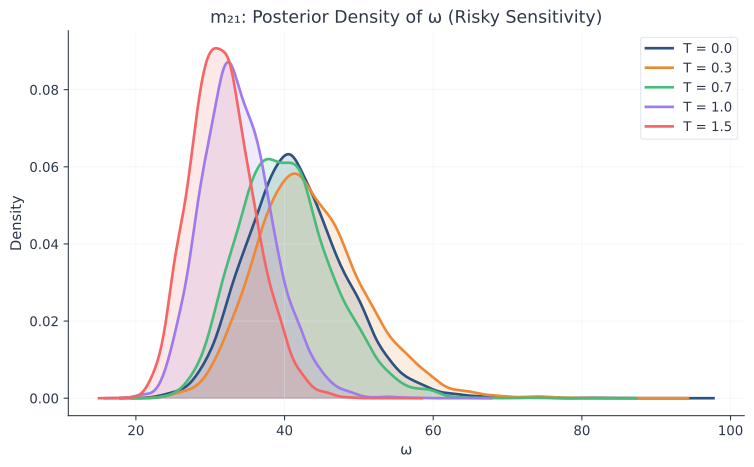
#| fig-cap: "Posterior density of ω (risky sensitivity) from m_21 at each temperature. The patterns mirror α—declining with temperature—but at lower absolute levels."
#| fig-height: 5
fig, ax = plt.subplots(figsize=(8, 5))

for i, t in enumerate(temperatures):
    draws = omega_draws['m_21'][t]
    kde = gaussian_kde(draws)
    x_grid = np.linspace(draws.min() * 0.8, draws.max() * 1.2, 300)
    ax.fill_between(x_grid, kde(x_grid), alpha=0.15, color=SEU_PALETTE[i])
    ax.plot(x_grid, kde(x_grid), color=SEU_PALETTE[i], linewidth=2,
            label=f'T = {t}')

ax.set_xlabel('ω')
ax.set_ylabel('Density')
ax.set_title('m₂₁: Posterior Density of ω (Risky Sensitivity)')
ax.legend(loc='upper right')
plt.tight_layout()
plt.show()
```
## Posterior Predictive Checks {#sec-ppc}
The augmented models produce separate posterior predictive check statistics for uncertain and risky choices. For each context, we compute three test statistics:
- **Log-likelihood (ll):** The total log-likelihood of the observed choices under the model — i.e., $\sum_i \log p(y_i^{\text{obs}} \mid \theta)$ — computed separately for uncertain and risky observations.
- **Modal choice frequency (modal):** The fraction of decision problems in which the alternative assigned the highest predicted probability by the model is the one actually chosen by the LLM.
- **Mean choice probability (prob):** The average predicted probability assigned to the observed choice across all problems — i.e., $\frac{1}{N}\sum_i p(y_i^{\text{obs}} \mid \theta)$.
The posterior predictive p-value is the proportion of replicated datasets where the statistic equals or exceeds the observed value; 0.5 indicates perfect calibration.
### m_11 PPCs
```{python}
#| label: tbl-ppc-m11
#| tbl-cap: "m_11 posterior predictive p-values. The uncertain-choice statistics are well-calibrated. The risky-choice modal and prob statistics run high, suggesting the model's shared α may be somewhat too low to fully account for the risky context's regularity."
#| echo: false
rows = []
for t in temperatures:
tk = temp_key_map[t]
p = ppc_summary['m_11'][tk]
rows.append({
'T': t,
'LL unc': f"{p['ppc_ll_uncertain']:.3f}",
'Modal unc': f"{p['ppc_modal_uncertain']:.3f}",
'Prob unc': f"{p['ppc_prob_uncertain']:.3f}",
'LL risky': f"{p['ppc_ll_risky']:.3f}",
'Modal risky': f"{p['ppc_modal_risky']:.3f}",
'Prob risky': f"{p['ppc_prob_risky']:.3f}",
'LL combined': f"{p['ppc_ll_combined']:.3f}",
})
pd.DataFrame(rows)
```
### m_21 PPCs
```{python}
#| label: tbl-ppc-m21
#| tbl-cap: "m_21 posterior predictive p-values. With a separate ω for risky choices, the risky PPCs are better calibrated than under m_11—particularly the modal and prob statistics, which no longer show systematic upward bias."
#| echo: false
rows = []
for t in temperatures:
tk = temp_key_map[t]
p = ppc_summary['m_21'][tk]
rows.append({
'T': t,
'LL unc': f"{p['ppc_ll_uncertain']:.3f}",
'Modal unc': f"{p['ppc_modal_uncertain']:.3f}",
'Prob unc': f"{p['ppc_prob_uncertain']:.3f}",
'LL risky': f"{p['ppc_ll_risky']:.3f}",
'Modal risky': f"{p['ppc_modal_risky']:.3f}",
'Prob risky': f"{p['ppc_prob_risky']:.3f}",
'LL combined': f"{p['ppc_ll_combined']:.3f}",
})
pd.DataFrame(rows)
```
### m_31 PPCs
```{python}
#| label: tbl-ppc-m31
#| tbl-cap: "m_31 posterior predictive p-values. The proportional model (ω = κ·α) produces PPC calibration intermediate between m_11 and m_21, consistent with its intermediate structural flexibility."
#| echo: false
rows = []
for t in temperatures:
tk = temp_key_map[t]
p = ppc_summary['m_31'][tk]
rows.append({
'T': t,
'LL unc': f"{p['ppc_ll_uncertain']:.3f}",
'Modal unc': f"{p['ppc_modal_uncertain']:.3f}",
'Prob unc': f"{p['ppc_prob_uncertain']:.3f}",
'LL risky': f"{p['ppc_ll_risky']:.3f}",
'Modal risky': f"{p['ppc_modal_risky']:.3f}",
'Prob risky': f"{p['ppc_prob_risky']:.3f}",
'LL combined': f"{p['ppc_ll_combined']:.3f}",
})
pd.DataFrame(rows)
```
### PPC Comparison
```{python}
#| label: fig-ppc-comparison
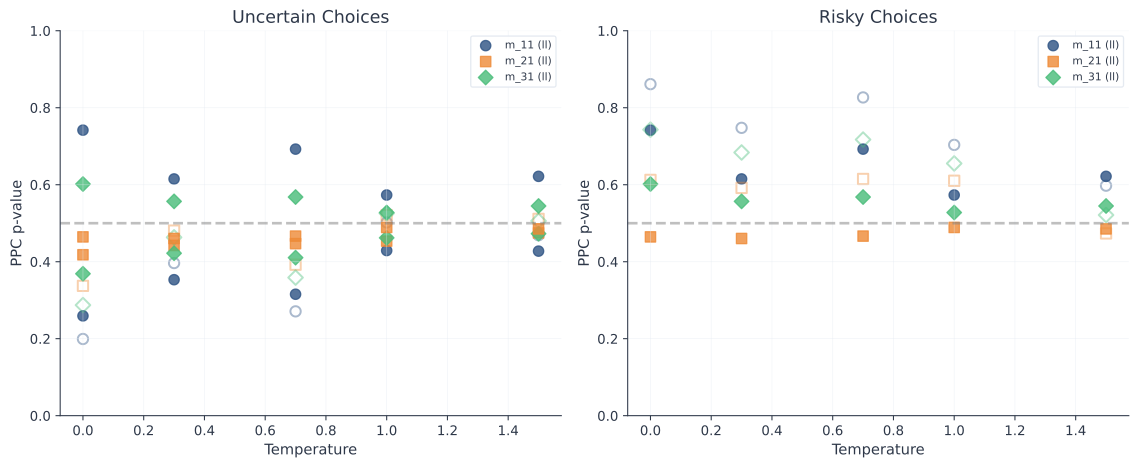
#| fig-cap: "PPC p-values across models and contexts. Left: uncertain choices. Right: risky choices. The ideal calibration line at 0.5 is shown as a dashed line. m_21 (separate ω) achieves the best risky-choice calibration."
#| fig-height: 5
fig, (ax1, ax2) = plt.subplots(1, 2, figsize=(12, 5))

model_colors = {'m_11': SEU_COLORS['primary'], 'm_21': SEU_COLORS['accent'], 'm_31': SEU_COLORS['success']}
model_markers = {'m_11': 'o', 'm_21': 's', 'm_31': 'D'}

# Uncertain PPCs
for model in ['m_11', 'm_21', 'm_31']:
    ll_vals = [ppc_summary[model][tk]['ppc_ll_uncertain'] for tk in temp_keys]
    prob_vals = [ppc_summary[model][tk]['ppc_prob_uncertain'] for tk in temp_keys]
    ax1.scatter(temperatures, ll_vals, color=model_colors[model],
                marker=model_markers[model], s=60, label=f'{model} (ll)', alpha=0.8)
    ax1.scatter(temperatures, prob_vals, color=model_colors[model],
                marker=model_markers[model], s=60, alpha=0.4, facecolors='none',
                edgecolors=model_colors[model], linewidths=1.5)

ax1.axhline(y=0.5, color='gray', linestyle='--', alpha=0.5)
ax1.set_xlabel('Temperature')
ax1.set_ylabel('PPC p-value')
ax1.set_title('Uncertain Choices')
ax1.set_ylim(0, 1)
ax1.legend(fontsize=8)

# Risky PPCs
for model in ['m_11', 'm_21', 'm_31']:
    ll_vals = [ppc_summary[model][tk]['ppc_ll_risky'] for tk in temp_keys]
    prob_vals = [ppc_summary[model][tk]['ppc_prob_risky'] for tk in temp_keys]
    ax1.scatter(temperatures, ll_vals, color=model_colors[model],
                marker=model_markers[model], s=60, alpha=0.8)
    ax2.scatter(temperatures, ll_vals, color=model_colors[model],
                marker=model_markers[model], s=60, label=f'{model} (ll)', alpha=0.8)
    ax2.scatter(temperatures, prob_vals, color=model_colors[model],
                marker=model_markers[model], s=60, alpha=0.4, facecolors='none',
                edgecolors=model_colors[model], linewidths=1.5)

ax2.axhline(y=0.5, color='gray', linestyle='--', alpha=0.5)
ax2.set_xlabel('Temperature')
ax2.set_ylabel('PPC p-value')
ax2.set_title('Risky Choices')
ax2.set_ylim(0, 1)
ax2.legend(fontsize=8)

plt.tight_layout()
plt.show()
```
The PPC analysis reveals a clear model-adequacy story:
- **Uncertain choices** are well-described by all three models, with p-values mostly in $[0.2, 0.6]$. This is expected — the uncertain likelihood shares the same structure as m_01, which showed good fit in [Report 1](../temperature_study/01_initial_study.qmd).
- **Risky choices under m_11** show systematically elevated `ppc_modal_risky` (0.71–0.96) and `ppc_prob_risky` (0.60–0.86): the model assigns even higher probability to observed choices than expected under its own generative process. This occurs because m_11's shared $\alpha$ is pulled toward a compromise between the two contexts.
- **m_21 resolves this miscalibration** by giving risky choices their own $\omega$, bringing all risky PPC p-values into the well-calibrated range.
- **m_31 falls between** the other two, consistent with its intermediate structural flexibility.
::: {.callout-important}
## Limitation: No Formal Information-Theoretic Model Comparison
The PPC analysis provides evidence of model *adequacy* — whether each model can reproduce observed data patterns — but does not quantify the predictive performance trade-off between models of different complexity. A formal model comparison using leave-one-out cross-validation (LOO-CV via Pareto-smoothed importance sampling) or the widely applicable information criterion (WAIC) would complement the PPC evidence, particularly since m_21 has an additional free parameter relative to m_11 and m_31. All models output pointwise log-likelihood values (`log_lik_uncertain`, `log_lik_risky`), making PSIS-LOO straightforward to compute. We note this as an important gap: the PPC-based preference for m_21 is supported by the specific pattern of misfit in m_11's risky-choice statistics, but formal information-theoretic comparison would strengthen the model selection conclusion. Future revisions of this report should include LOO-CV with elpd differences and standard errors across models.
:::
## Monotonicity Analysis {#sec-monotonicity}
### Global Slope: α
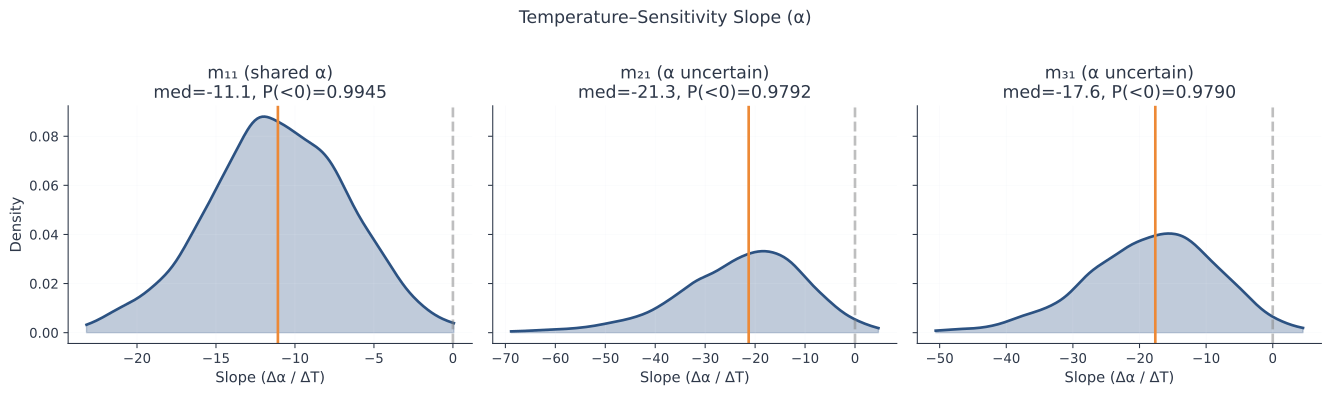
We replicate the draw-wise slope analysis from [Report 1](../temperature_study/01_initial_study.qmd). For each posterior draw, we regress $\alpha$ on temperature across the five conditions and collect the slope coefficient.
```{python}
#| label: fig-slope-alpha
#| fig-cap: "Posterior distribution of the slope Δα/ΔT for each model. All three models place virtually all posterior mass below zero, confirming the temperature–sensitivity relationship is robust to model specification. m_11 (shared α) yields the tightest slope posterior."
#| fig-height: 5
temp_array = np.array(temperatures)

fig, axes = plt.subplots(1, 3, figsize=(14, 4), sharey=True)

for ax, model, title in zip(axes, ['m_11', 'm_21', 'm_31'],
                             ['m₁₁ (shared α)', 'm₂₁ (α uncertain)', 'm₃₁ (α uncertain)']):
    n_draws = len(alpha_draws[model][temperatures[0]])
    slope_draws = []
    for draw_idx in range(n_draws):
        alpha_vec = np.array([alpha_draws[model][t][draw_idx] for t in temperatures])
        # OLS: b = cov(T, alpha) / var(T)
        b = np.polyfit(temp_array, alpha_vec, 1)[0]
        slope_draws.append(b)
    slope_draws = np.array(slope_draws)

    kde = gaussian_kde(slope_draws)
    x_grid = np.linspace(np.percentile(slope_draws, 0.5),
                          np.percentile(slope_draws, 99.5), 300)
    ax.fill_between(x_grid, kde(x_grid), alpha=0.3, color=SEU_COLORS['primary'])
    ax.plot(x_grid, kde(x_grid), color=SEU_COLORS['primary'], linewidth=2)

    median_slope = np.median(slope_draws)
    q05, q95 = np.percentile(slope_draws, [5, 95])
    ax.axvline(x=median_slope, color=SEU_COLORS['accent'], linestyle='-', linewidth=2)
    ax.axvline(x=0, color='gray', linestyle='--', alpha=0.5)

    prob_neg = np.mean(slope_draws < 0)
    ax.set_xlabel('Slope (Δα / ΔT)')
    ax.set_title(f'{title}\nmed={median_slope:.1f}, P(<0)={prob_neg:.4f}')
    ax.grid(alpha=0.2)

axes[0].set_ylabel('Density')
plt.suptitle('Temperature–Sensitivity Slope (α)', fontsize=13, y=1.02)
plt.tight_layout()
plt.show()
```
### Global Slope: ω
```{python}
#| label: fig-slope-omega
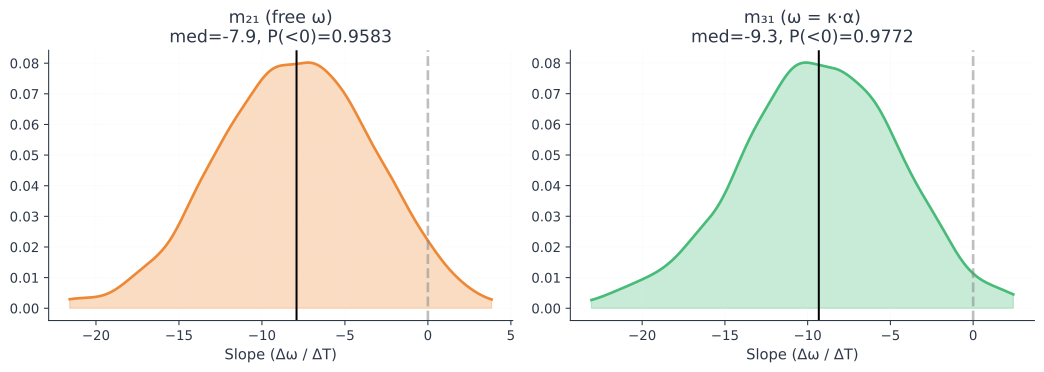
#| fig-cap: "Posterior distribution of the slope Δω/ΔT from m_21 (free ω) and m_31 (derived ω = κ·α). Both models confirm that risky sensitivity also declines with temperature."
#| fig-height: 4
fig, (ax1, ax2) = plt.subplots(1, 2, figsize=(11, 4))

for ax, model, title, color in zip(
    [ax1, ax2], ['m_21', 'm_31'],
    ['m₂₁ (free ω)', 'm₃₁ (ω = κ·α)'],
    [SEU_COLORS['accent'], SEU_COLORS['success']]):

    n_draws = len(omega_draws[model][temperatures[0]])
    slope_draws = []
    for draw_idx in range(n_draws):
        omega_vec = np.array([omega_draws[model][t][draw_idx] for t in temperatures])
        b = np.polyfit(temp_array, omega_vec, 1)[0]
        slope_draws.append(b)
    slope_draws = np.array(slope_draws)

    kde = gaussian_kde(slope_draws)
    x_grid = np.linspace(np.percentile(slope_draws, 0.5),
                          np.percentile(slope_draws, 99.5), 300)
    ax.fill_between(x_grid, kde(x_grid), alpha=0.3, color=color)
    ax.plot(x_grid, kde(x_grid), color=color, linewidth=2)

    median_slope = np.median(slope_draws)
    prob_neg = np.mean(slope_draws < 0)
    ax.axvline(x=median_slope, color='black', linestyle='-', linewidth=1.5)
    ax.axvline(x=0, color='gray', linestyle='--', alpha=0.5)
    ax.set_xlabel('Slope (Δω / ΔT)')
    ax.set_title(f'{title}\nmed={median_slope:.1f}, P(<0)={prob_neg:.4f}')
    ax.grid(alpha=0.2)

axes[0].set_ylabel('Density')
plt.tight_layout()
plt.show()
```
### Pairwise Comparisons (m_11)
```{python}
#| label: tbl-pairwise-m11
#| tbl-cap: "m_11: Posterior probability that α is higher at the lower temperature. The strong-separation / weak-separation pattern from the m_01 analysis (Report 1) replicates exactly."
#| echo: false
from itertools import combinations
pair_rows = []
for t_low, t_high in combinations(temperatures, 2):
draws_low = alpha_draws['m_11'][t_low]
draws_high = alpha_draws['m_11'][t_high]
prob = np.mean(draws_low > draws_high)
pair_rows.append({
'Pair': f'T={t_low} vs T={t_high}',
'P(α_low > α_high)': f'{prob:.4f}',
'Strength': '●●●' if prob > 0.95 else ('●●' if prob > 0.80 else ('●' if prob > 0.65 else '○')),
})
pd.DataFrame(pair_rows)
```
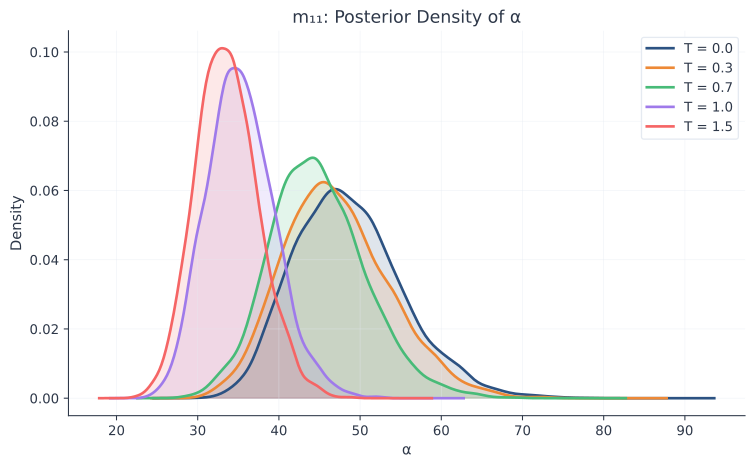
The pairwise structure exactly replicates [Report 1](../temperature_study/01_initial_study.qmd): strong separation between $T = 0.0$ and $T \geq 1.0$, moderate separation between middle and high temperatures, and near-indistinguishability between $T = 0.3$ and $T = 0.7$.
## Formal Context Comparison: Uncertain vs. Risky Sensitivity {#sec-context-comparison}
The most novel finding of this report is that the LLM exhibits lower EU sensitivity in the risky context than in the uncertain context. This section provides formal quantification of that claim.
### Posterior Probability of α > ω (m_21)
```{python}
#| label: tbl-alpha-gt-omega
#| tbl-cap: "m_21: Posterior probability that uncertain sensitivity α exceeds risky sensitivity ω at each temperature, with the median difference Δ = α − ω."
#| echo: false
context_rows = []
for t in temperatures:
tk = temp_key_map[t]
a_draws = alpha_draws['m_21'][t]
o_draws = omega_draws['m_21'][t]
diff = a_draws - o_draws
prob_gt = np.mean(a_draws > o_draws)
context_rows.append({
'Temp': t,
'P(α > ω)': f'{prob_gt:.4f}',
'Median Δ': f'{np.median(diff):.1f}',
'90% CI of Δ': f'[{np.percentile(diff, 5):.1f}, {np.percentile(diff, 95):.1f}]',
})
pd.DataFrame(context_rows)
```
### Aggregate Test: Mean Difference Across Temperatures (m_21)
```{python}
#| label: tbl-aggregate-context
#| tbl-cap: "Aggregate measure of the context-dependent sensitivity gap. For each posterior draw, the five per-temperature α − ω differences are averaged, yielding a single summary of the overall gap."
#| echo: false
n_draws = len(alpha_draws['m_21'][temperatures[0]])
mean_diffs = []
for draw_idx in range(n_draws):
diffs = [alpha_draws['m_21'][t][draw_idx] - omega_draws['m_21'][t][draw_idx]
for t in temperatures]
mean_diffs.append(np.mean(diffs))
mean_diffs = np.array(mean_diffs)
print(f"Aggregate mean(α − ω) across temperatures:")
print(f" Median: {np.median(mean_diffs):.1f}")
print(f" 90% CI: [{np.percentile(mean_diffs, 5):.1f}, {np.percentile(mean_diffs, 95):.1f}]")
print(f" P(mean > 0): {np.mean(mean_diffs > 0):.4f}")
```
::: {.callout-note}
## Interpreting the Aggregate Test
The aggregate P(mean(α − ω) > 0) provides a single summary of the strength of evidence for context-dependent sensitivity across all temperatures. This draw-wise averaging treats the per-temperature estimates as independent (since they are fit separately), which is appropriate given the study design but does not pool information across temperatures.
:::
### Posterior Probability of κ < 1 (m_31)
```{python}
#| label: tbl-kappa-lt-1
#| tbl-cap: "m_31: Posterior probability that the proportionality parameter κ is below 1.0 at each temperature. κ < 1 indicates lower risky sensitivity relative to uncertain sensitivity."
#| echo: false
kappa_rows = []
for t in temperatures:
draws = kappa_draws[t]
prob_lt1 = np.mean(draws < 1.0)
kappa_rows.append({
'Temp': t,
'κ median': f'{np.median(draws):.3f}',
'P(κ < 1)': f'{prob_lt1:.4f}',
'90% CI': f'[{np.percentile(draws, 5):.3f}, {np.percentile(draws, 95):.3f}]',
})
pd.DataFrame(kappa_rows)
```
### Pairwise Comparisons: ω (m_21)
```{python}
#| label: tbl-pairwise-omega
#| tbl-cap: "m_21: Posterior probability that ω (risky sensitivity) is higher at the lower temperature. The temperature–sensitivity gradient is present but may differ in strength from the α gradient."
#| echo: false
omega_pair_rows = []
for t_low, t_high in combinations(temperatures, 2):
draws_low = omega_draws['m_21'][t_low]
draws_high = omega_draws['m_21'][t_high]
prob = np.mean(draws_low > draws_high)
omega_pair_rows.append({
'Pair': f'T={t_low} vs T={t_high}',
'P(ω_low > ω_high)': f'{prob:.4f}',
'Strength': '●●●' if prob > 0.95 else ('●●' if prob > 0.80 else ('●' if prob > 0.65 else '○')),
})
pd.DataFrame(omega_pair_rows)
```
The pairwise ω comparison clarifies whether the temperature–sensitivity gradient operates similarly in the risky context. If the pairwise probabilities are systematically lower for ω than for α (@tbl-pairwise-m11), this would indicate that risky sensitivity is not only lower in level but also less responsive to temperature — a more nuanced finding.
## Cross-Study Comparison {#sec-cross-study}
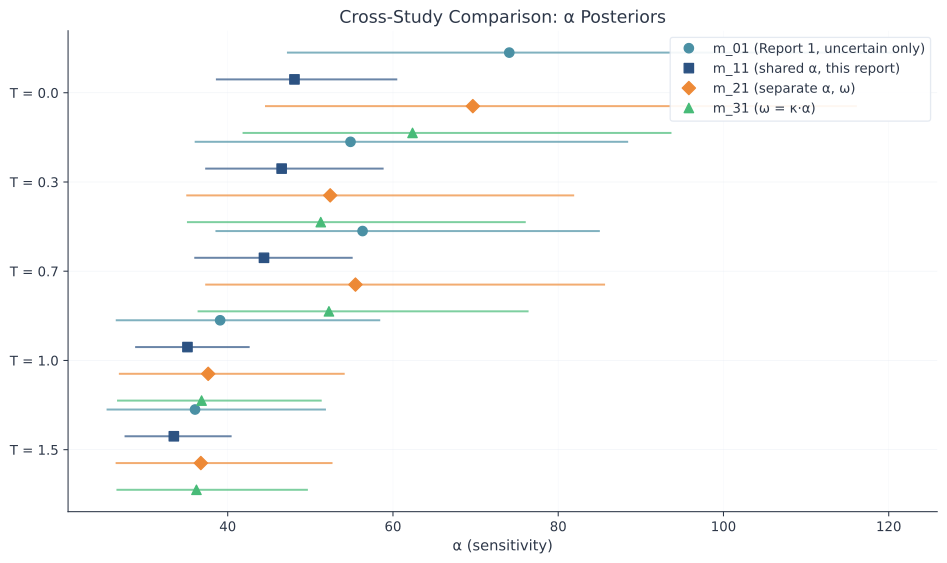
```{python}
#| label: fig-cross-study
#| fig-cap: "Cross-model consistency check of α posteriors from the initial m_01 study and the augmented m_11, m_21, and m_31 models *fit to the same uncertain-choice data*. Labels: m_01 (Report 1, uncertain only), m_11 (shared α, this report), m_21 (separate α and ω, this report), m_31 (proportional ω = κ·α, this report). Because all four fits share the uncertain-choice data, the agreement across models is a within-dataset consistency check on the augmented model structure, not an independent replication of the temperature pattern."
#| fig-height: 6
fig, ax = plt.subplots(figsize=(10, 6))

model_configs = [
    ('m_01', 'm_01 (Report 1, uncertain only)', m01_analysis['summary_table'], SEU_COLORS['secondary'], 'o', 0.45),
    ('m_11', 'm_11 (shared α, this report)', None, SEU_COLORS['primary'], 's', 0.15),
    ('m_21', 'm_21 (separate α, ω)', None, SEU_COLORS['accent'], 'D', -0.15),
    ('m_31', 'm_31 (ω = κ·α)', None, SEU_COLORS['success'], '^', -0.45),
]

y_positions = np.arange(len(temperatures))[::-1]

for model_key, model_label, summary_data, color, marker, offset in model_configs:
    for i, t in enumerate(temperatures):
        y = y_positions[i] + offset

        if model_key == 'm_01':
            entry = summary_data[i]
            median = entry['median']
            q05 = entry['ci_low']
            q95 = entry['ci_high']
        else:
            tk = temp_key_map[t]
            p = param_summary[model_key][tk]
            median = p['alpha_median']
            q05 = p['alpha_q05']
            q95 = p['alpha_q95']

        ax.plot([q05, q95], [y, y], color=color, linewidth=1.5, alpha=0.7)
        ax.plot(median, y, marker, color=color, markersize=7, zorder=5,
                label=model_label if i == 0 else '')

ax.set_yticks(y_positions)
ax.set_yticklabels([f'T = {t}' for t in temperatures])
ax.set_xlabel('α (sensitivity)')
ax.set_title('Cross-Study Comparison: α Posteriors')
ax.legend(loc='upper right', fontsize=10)
ax.grid(axis='x', alpha=0.3)

plt.tight_layout()
plt.show()
```
Several patterns emerge from the cross-study comparison. An important caveat: the uncertain-choice data in the augmented models (m_11, m_21, m_31) are *the same data* as in m_01, so the α estimates from the augmented models are not independent of the m_01 estimates. This comparison is therefore a *consistency check*—verifying that the augmented model structure does not distort the uncertain-context estimates—rather than an independent replication.
1. **Qualitative consistency.** All four models agree on the direction and approximate shape of the temperature–sensitivity relationship. The ordering $\alpha(T\!=\!0.0) > \alpha(T\!=\!0.3) \approx \alpha(T\!=\!0.7) > \alpha(T\!=\!1.0) > \alpha(T\!=\!1.5)$ is preserved.
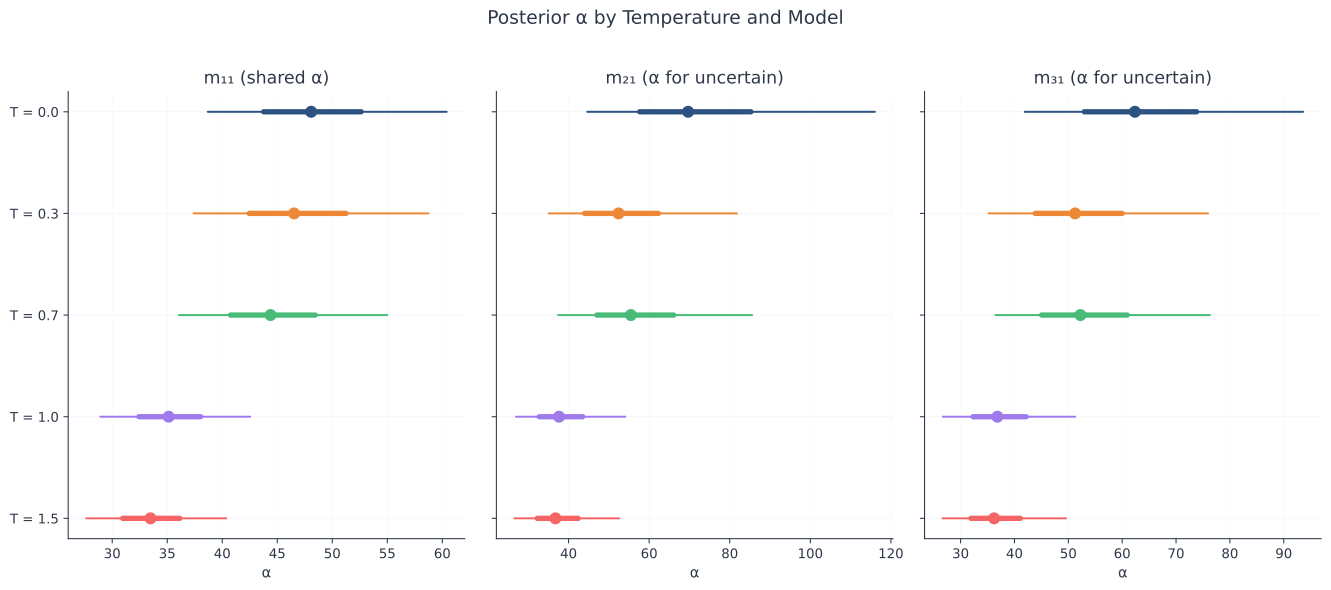
2. **m_11 produces the tightest posteriors.** By forcing a single $\alpha$ to explain both 300 uncertain and 300 risky choices, m_11 achieves SDs roughly half those of m_01 (which used 300 uncertain choices alone). The medians are somewhat lower than m_01's — a consequence of the shared $\alpha$ being a compromise between the two contexts, with the risky data favoring lower values.
3. **m_21 and m_31 recover m_01-like α values.** When the risky context is given its own sensitivity parameter ($\omega$ or $\kappa \cdot \alpha$), the uncertain-context $\alpha$ estimates closely match the m_01 values. This is expected as a necessary consequence of the shared uncertain-choice likelihood: the m_01 and m_21/m_31 models fit the same uncertain observations with the same structural assumptions. The consistency confirms that the augmented model does not introduce distortion, rather than providing independent confirmation of the m_01 estimates.
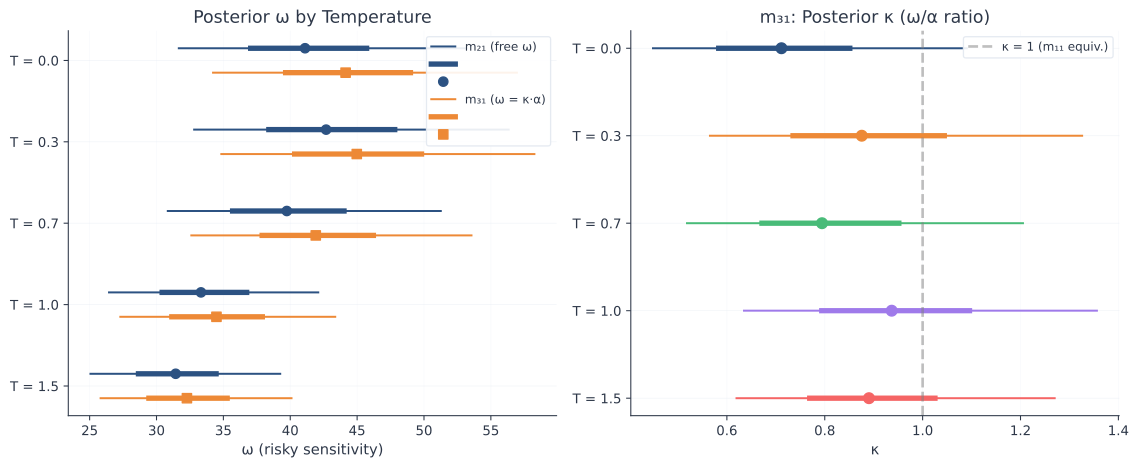
4. **The $\alpha/\omega$ gap is substantive.** Under m_21 at $T = 0.0$, the median $\alpha \approx 70$ while the median $\omega \approx 41$. As quantified formally in @sec-context-comparison, the LLM is approximately 1.7× more sensitive to EU differences in the uncertain context than in the risky context.
## Discussion {#sec-discussion}
### Summary of Findings
This study demonstrates three key results:
1. **Temperature–sensitivity replication.** The negative association between sampling temperature and estimated SEU sensitivity $\alpha$ — first established in [Report 1](../temperature_study/01_initial_study.qmd) using the m_01 model — is robust to the inclusion of risky alternatives and to the choice of augmented model (m_11, m_21, m_31). The qualitative pattern — high sensitivity at greedy decoding, a marked decrease between $T = 0.7$ and $T = 1.0$, and the near-indistinguishability of $T = 0.3$ and $T = 0.7$ — replicates exactly.
2. **Context-dependent sensitivity.** Under m_21 and m_31, the LLM's sensitivity to EU maximization is consistently *lower* in the risky context (where probabilities are stated explicitly) than in the uncertain context (where probabilities are inferred from features). The m_31 proportionality parameter $\kappa$ clusters below 1.0 at every temperature level, with medians ranging from 0.71 to 0.94.
3. **Model adequacy.** Posterior predictive checks support m_21 as the best-calibrated model: its separate $\omega$ parameter resolves the upward bias in risky-choice PPC statistics that m_11 exhibits. The proportional model m_31 provides a reasonable compromise, but does not match m_21's calibration at all temperatures.
### Interpretation: Why Is Risky Sensitivity Lower?
The finding that $\omega < \alpha$ — now formally quantified in @sec-context-comparison — is a robust empirical pattern, but its *explanation* remains open. The interpretations below are **post hoc**: they were formulated after observing the data and cannot be discriminated by the current design. The data establish the descriptive fact; mechanistic explanation requires follow-up study.
- **Format effect.** When probabilities are stated numerically (risky context), the LLM may process them less effectively than when probability-relevant information is embedded in natural-language descriptions (uncertain context). The softmax token sampling introduces noise at the token level, which may compound differently across the two representations. This hypothesis could in principle be tested by presenting risky alternatives in natural-language format (e.g., "about a 90% chance of neither claim being approved") and observing whether sensitivity rises to uncertain-context levels.
- **Calibration asymmetry.** The feature-to-probability mapping $\psi = \text{softmax}(\beta \cdot w)$ is learned jointly with $\alpha$, and may effectively "sharpen" the inferred probability distributions in ways that favor EU-aligned choices. The risky context has no such adaptive layer. This is partially testable: if the estimated subjective probabilities $\psi_r$ under the fitted model are more "peaked" (lower entropy) than the stated risky simplexes, this would be consistent with the β layer acting as an adaptive sharpening mechanism.
- **Utility estimation precision.** In the risky context, the expected utilities $\eta^{(r)} = x' \upsilon$ are exact given $\upsilon$, creating very fine EU differences between alternatives with similar probability profiles. When many alternatives have nearly equal EU, even moderate sensitivity $\omega$ produces near-uniform choice probabilities. This could be assessed by comparing the distribution of EU differences among alternatives in risky vs. uncertain problems.
Any of these mechanisms — or some combination — could be operative; the current data do not discriminate among them.
### Confounds in the Uncertain/Risky Comparison
Beyond the post hoc nature of the interpretations above, the uncertain and risky contexts differ in ways that go beyond probability format:
- **Stimulus complexity.** Uncertain alternatives are derived from natural-language claim descriptions processed through embedding and PCA ($D = 32$ features per alternative), while risky alternatives present explicit probability simplexes ($K = 3$ values).
- **Dimensionality and estimation burden.** The uncertain model estimates a $K \times D$ matrix $\beta$ jointly with $\alpha$; the risky model takes probabilities as given.
- **Representation pathway.** Uncertain probabilities pass through a learned softmax mapping; risky probabilities enter the EU calculation directly.
These differences mean that the $\alpha > \omega$ finding could reflect task structure rather than probability-format effects per se. A matched design — where the same 30 stimulus profiles are used in both contexts, with probabilities either inferred or stated — would provide cleaner causal attribution. The current finding should be interpreted as: *as operationalized in this design*, risky choices show lower sensitivity to EU differences.
### Connection to the JDM Risk–Ambiguity Literature
The distinction between our "uncertain" and "risky" contexts maps directly onto the risk–ambiguity distinction that has been central to JDM since Ellsberg (1961). In the uncertain context, the LLM must infer probabilities from text features — analogous to the "ambiguity" condition where probabilities are unknown or imprecise. In the risky context, probabilities are stated explicitly — the canonical "risk" condition.
A large body of research on human decision-making has documented *ambiguity aversion*: people tend to prefer options with known probabilities over options with unknown probabilities, even when expected values are equivalent (Camerer & Weber, 1992; Trautmann & van de Kuilen, 2015). This typically manifests as more conservative choice under ambiguity.
The finding that the LLM shows *higher* EU sensitivity under uncertainty/ambiguity than under risk is interesting in light of this literature, though direct comparison requires caution. Higher $\alpha$ means choices are more tightly aligned with EU maximization — which could be seen as *more rational* rather than more conservative. Whether this pattern reflects something analogous to human ambiguity attitudes, or is an artifact of the adaptive $\beta$ layer, remains an open question. The [Ellsberg study](../ellsberg_study/01_ellsberg_study.qmd) in this series engages more directly with classic Ellsberg-style ambiguity manipulations; cross-referencing those findings with the present results may shed light on whether the sensitivity asymmetry reflects a general feature of LLM probability processing.
### Practical Implications
The finding that temperature affects LLM rationality has implications for AI deployment. At greedy decoding ($T = 0.0$), the LLM's choices are most closely aligned with EU maximization — potentially desirable in applications where consistent, utility-maximizing decisions are valued (e.g., automated triage, recommendation systems) but potentially undesirable where diversity of response or exploration is needed. The additional finding that context format affects sensitivity suggests that how probabilities are presented to an LLM may matter for the quality of its decisions, independent of the temperature setting.
### Limitations and Next Steps
**Independent temperature fits.** The current analysis fits each temperature condition independently. A hierarchical model that pools information across temperatures — e.g., $\log \alpha(T) = a + bT$, $\log \omega(T) = c + dT$ — would directly estimate slope parameters, test whether the temperature effect on $\omega$ parallels that on $\alpha$, and obviate the need for draw-wise slope computation across independent fits. The m_31 structure ($\omega = \kappa \alpha$) would be particularly amenable to a hierarchical extension where $\kappa$ is allowed to vary with temperature. The near-equality of $T = 0.3$ and $T = 0.7$ estimates motivates investigation of whether the relationship is piecewise or smoothly nonlinear.
**Precision on κ.** The $\kappa < 1$ finding, while consistent across temperatures, has wide credible intervals; a study with larger $N$ (more risky problems per temperature) would improve precision on this parameter and enable sharper discrimination between m_11 and m_31.
**Prior sensitivity.** The $\alpha$ prior — Lognormal(3.0, 0.75) — is carried forward from [Report 1](../temperature_study/01_initial_study.qmd) without robustness checking, and the $\omega$ prior in m_21 adopts the same hyperparameters by symmetry. The $\kappa$ prior in m_31 — Lognormal(0, 0.5) — is moderately informative. Refitting under alternative priors (e.g., $\alpha, \omega \sim \text{Lognormal}(2.5, 1.0)$) and verifying that the qualitative findings — the temperature gradient and the $\omega < \alpha$ pattern — are preserved would strengthen the robustness of the conclusions. Prior-to-posterior contraction ratios for the key parameters would further quantify the data's influence relative to the prior.
**Single LLM and task domain.** All results are from GPT-4o on the insurance triage task. The [Ellsberg study](../ellsberg_study/01_ellsberg_study.qmd) and [GPT-4o Ellsberg study](../gpt4o_ellsberg_study/01_gpt4o_ellsberg_study.qmd) in this series provide some cross-task context, while the [Claude Insurance study](../claude_insurance_study/01_claude_insurance_study.qmd) provides cross-LLM context on the same task domain. The [factorial synthesis](../factorial_synthesis/01_factorial_synthesis.qmd) formally disentangles LLM and task effects.
### Construct Validity Revisited
Returning to the construct-validity framing introduced at the top of
this report: the empirical results of this study illustrate, in
miniature, exactly what is gained by moving from the m_0 / m_01
family to a design with risky alternatives. The temperature–$\alpha$
relationship from [Report 1](../temperature_study/01_initial_study.qmd)
is a layer-(2) finding that survives the move (it replicates under
all three augmented models), but the m_31 estimate of $\kappa$ is a
layer-(3)–adjacent quantity that the m_0 / m_01 family **cannot
produce at all** — and the data do indeed locate $\kappa$
substantively below 1.0 across all temperatures. That this is
possible only because risky choices give $\delta$ direct identifying
information is the methodological point.
For the planned alignment study (see
[`prompts/hierarchical_alignment_study_plan.md`](../../../prompts/hierarchical_alignment_study_plan.md)),
the implications are concrete:
1. **The h_m01-based first wave is layer (2) by construction** —
contrasts on $\log\alpha$ across alignment manipulations — and
inherits the m_01 caveats spelled out in [Report 1](../temperature_study/01_initial_study.qmd).
2. **A second wave that adds risky alternatives** would lift the
alignment study into the same identification regime as the
present m_11 / m_21 / m_31 family, allowing context-comparison
parameters analogous to $\kappa$ — for example, prompt-condition
ratios of risky-vs-uncertain sensitivity — that are robust to the
absolute scaling of $u_\theta$.
3. **The wide credible intervals on $\kappa$ here at $N = 300$** are
a direct planning input for any such follow-up: precise
estimation of context-comparison parameters demands more risky
problems per cell than precise estimation of $\alpha$ alone.
In short, the present study should be read both as a substantive
extension of the temperature finding *and* as the methodological
template for the m_1 / m_2 / m_3-family follow-up that the
construct-validity discussion in [Report 1](../temperature_study/01_initial_study.qmd)
identifies as the principled way to move beyond the m_0 / m_01
identification limit.
### Transparency Note
The decision to fit three models (m_11, m_21, m_31) was pre-specified as part of the study design — the model family was defined in advance based on the nesting structure established in the [foundational reports](../../foundations/07_generalizing_sensitivity.qmd). The specific finding that m_21 shows better PPC calibration than m_11, and the subsequent focus on the $\alpha > \omega$ pattern, are data-driven and should be regarded as exploratory rather than confirmatory. The formal context comparison (@sec-context-comparison) was added during revision to provide rigorous quantification of a pattern that was initially presented only qualitatively.